

Imam al-Muslimeen: The Leader of the Monotheists and Commander of the Hadith Scholars
Imam Abu Abdullah Muhammad ibn Isma'il al-Bukhari (Rahimahullah) is among those illustrious sons of Islam whose noble name will continue to live on in this world alongside the name of Islam and the Qur'an. His dedicated efforts in scrutinizing, compiling, and organizing the Hadiths of the Messenger of Allah ﷺ will forever be honored and appreciated by future generations of Muslims.
His blessed emergence is a manifestation of the Qur'anic prophecy revealed by Allah the Exalted in Surah al-Jumu'ah:
«وَآخَرِينَ مِنْهُمْ لَمَّا يَلْحَقُوا بِهِمْ وَهُوَ الْعَزِيزُ الْحَكِيمُ» [62:3]
"And others among them who have not yet joined them. And He is the Almighty, the All-Wise."
That is, after the era of prophethood, there will be other people who will be endowed with the knowledge of the Book and wisdom. Imam al-Bukhari (Rahimahullah) is undoubtedly among the foremost of these blessed souls.
The Messenger of Allah ﷺ had said that people from among the Persians will emerge, and even if religious knowledge were to be found near the star of Thurayya (Pleiades), they would reach there to retrieve it. Imam al-Bukhari (Rahimahullah) was truly one of those noble individuals.
Lineage and Early Life of Imam Bukhari
The title "Commander of the Faithful in Hadith" was conferred upon our Master, Imam Bukhari (may Allah have mercy on him). His noble name was “Muhammad,” and his kunyah (honorific title) was Abu Abdullah. His lineage is: Muhammad ibn Isma'il ibn Ibrahim ibn Mughirah ibn Bardizbah ibn Badhdhubah al-Ju‘fi al-Bukhari.
Hafiz Ibn Hajar (may Allah have mercy on him) wrote that Bardizbah was a fire-worshipper, indicating Imam Bukhari’s Persian ancestry. His great-grandfather, Mughirah, accepted Islam at the hands of Yaman al-Ju‘fi, the ruler of Bukhara, and settled permanently in the city. This is why Imam Bukhari (may Allah have mercy on him) is referred to as "al-Ju‘fi al-Bukhari."
The Scholarly Family of Imam Bukhari
His noble father, the eminent scholar Mawlana Isma'il (may Allah have mercy on him), was among the great hadith scholars. His kunyah was Abu al-Hasan. He was one of the distinguished students of Imam Malik (may Allah have mercy on him), and also narrated hadith from Hammad ibn Zayd, Abu Mu‘awiyah, and Abdullah ibn al-Mubarak, among others.
Among his students were Ahmad ibn Hafs, Nasr ibn Husayn, and others. Mawlana Isma'il was a person of extreme piety, religiosity, and scrupulousness—especially concerning the consumption of lawful (halal) earnings. Not a single dirham of his wealth was questionable or forbidden.
His student, Ahmad ibn Hafs, narrated: “I was present at the time of Mawlana Isma'il’s death. At that moment, he said, ‘I leave this world without even a single doubtful dirham among my earnings.’”
Birth and Early Childhood of Imam Bukhari
Imam Bukhari (may Allah sanctify his soul) was born in the city of Bukhara on Friday, 13th Shawwal, 194 AH, after the Jumu‘ah prayer. It is a rare honor in the Muslim Ummah that both father and son are hadith scholars—and in this case, the son rose to become the chief of all hadith scholars.
Just as the Prophet Yusuf (peace be upon him) was described as “the noble, son of the noble, son of the noble,” similarly, Imam Bukhari (may Allah have mercy on him) is rightfully called a “hadith scholar, son of a hadith scholar.”
Unfortunately, his father did not live long enough to witness his son’s academic brilliance, having passed away while Imam Bukhari was still a child.
Upbringing Under His Pious Mother
The complete responsibility for Imam Bukhari’s upbringing fell upon his noble mother, a devout, God-conscious woman who spent her nights in worship. Considering the religious and scholarly stature of both parents, one can easily imagine the spiritually rich and disciplined environment in which Imam Bukhari was raised and educated.
The Miraculous Healing of Imam Bukhari's Eyesight in Childhood
Fanjār in *Tārīkh Bukhārā* and Lāsakāʾī in *Sharḥ al-Sunnah*, under the chapter *Karamāt al-Awliyāʾ* (Miracles of the Saints), narrate that during his childhood, Imam Bukhari (may Allah have mercy on him) lost his eyesight.
His noble mother, already burdened by the grief of widowhood, was struck by this sudden tragedy. The physicians were helpless in providing a cure. His mother wept night and day over her orphaned son’s condition and persistently prayed for him.
Finally, one night after the ‘Isha prayer, she fell asleep on her prayer mat, weeping and praying. In her dream, Khalīlullāh Ibrāhīm (peace be upon him) appeared and gave her glad tidings, saying: “Due to your weeping and supplications, Allah the Almighty has restored your son's eyesight.”
When morning came, her son’s vision had truly been restored. Later, Allah granted him such exceptional clarity of sight that he famously wrote the complete manuscript of *Tārīkh al-Kabīr* under the light of the moon.
Temporary Loss and Restoration of Vision During His Journey
Tāj al-Dīn al-Subkī mentions in *Ṭabaqāt al-Kubrā* that once, while traveling in intense heat and sunlight in pursuit of knowledge, Imam Bukhari’s eyesight diminished once again.
Upon reaching Khurāsān, he consulted a skilled physician who advised him to shave his head and apply a poultice made of marshmallow flowers (*gul-e-khatmī*). By the grace of Allah, this treatment completely restored his vision.
Early Love for Hadith and Participation in Study Circles
By the age of ten, Imam Bukhari had completed his elementary education. Even at this tender age, he developed a deep passion for memorizing the noble sayings of the Prophet Muhammad ﷺ.
He began actively participating in various scholarly gatherings and circles of Hadith, marking the beginning of a legendary journey in the field of Islamic scholarship.
The Flourishing Centers of Islamic Knowledge in Bukhara
In those days, the city of Bukhara was home to numerous centers of Qur'anic and Hadith sciences. The air resounded with the sacred phrases "Qāla Allāh" (Allah said) and "Qāla al-Rasūl" (The Messenger said). Imam Bukhari began to benefit from these scholarly institutions.
A Remarkable Correction at Age Eleven
One day, Imam Bukhari attended the study circle of Imam Dākhilī, the Hadith scholar of Bukhara. During the narration of a hadith chain, Imam Dākhilī stated: “Sufyan from Abu al-Zubayr from Ibrahim.” Imam Bukhari gently interjected, “Sir, this isn’t the correct chain, because Abu al-Zubayr did not narrate from Ibrahim.” Startled by such correction from a young student, Imam Dākhilī responded with slight annoyance. With utmost respect, Imam Bukhari softly suggested, “If you have the original book, perhaps you could review it.” Upon checking the original manuscript at home, Imam Dākhilī realized the young student was correct. Upon returning, he asked Imam Bukhari what the correct chain was.
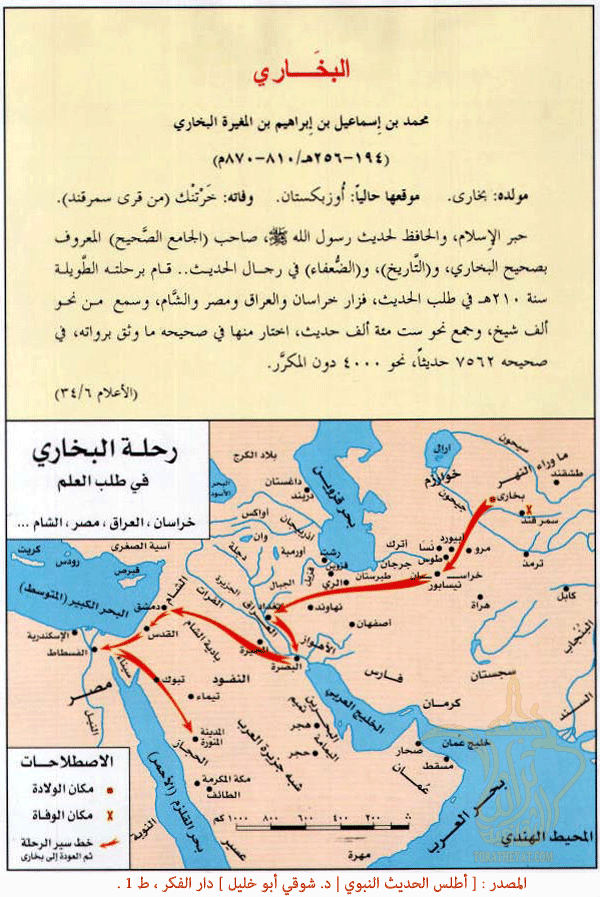
The Meaning and Importance of "Rihlah" (Journey) in Hadith Studies
The word "Rihlah" literally means to travel or depart, but in the terminology of the hadith scholars, it became a specific term for the journey undertaken to acquire hadith or to obtain a high chain of narration (Isnaad Aali). From the blessed times of the Companions and the Tabi'een, the leading figures of the Ummah developed a passion for setting out on long journeys in the pursuit of knowledge. The Holy Qur'an instructs that a group of Muslims must go forth to gain deep understanding of the religion. In compliance with this divine directive, the hadith scholars (may Allah have mercy on them all) girded themselves for travel, undertaking such rigorous and distant expeditions for this sacred purpose that they became unparalleled in the history of the world.
Regarding the travels of Imam Bukhari (may Allah have mercy on him), the names of many far-off cities such as Marw, Balkh, Herat, Nishapur, Rayy, and others have been recorded. He traveled to almost every Islamic region in pursuit of hadith.
Ja‘far ibn Muhammad Khattan says, “I heard Imam Bukhari (may Allah have mercy on him) say: ‘I have heard hadith from more than one thousand teachers, and I have preserved not only all the hadith I possess but also the complete details of their chains and narrators.’”
Life and Travels of Imam Bukhari
Syed al-Muhaddithin, Ameer al-Mu'mineen fil-Hadith Imam Bukhari (رحمہ اللہ) set out for Hajj in the 16th year of his life (210 AH) along with his respected mother and honorable brother Ahmad, reaching Makkah al-Mukarramah. In this center of Islam, he met great scholars and hadith narrators, and with his mother's permission, he settled in Makkah after Hajj to pursue the knowledge of Hadith. At that time, Makkah was home to prominent figures such as Abdullah bin Yazid, Abu Bakr Abdullah bin Zubair, Abu al-Waleed Ahmad bin al-Azraqi, and Allama Humaydi.
He stayed in Makkah for two full years, attaining both external and internal excellence, and then traveled to Madinah al-Munawwarah in 212 AH where he benefited from the renowned muhaddithin like Mutarrif bin Abdullah, Ibrahim bin Mundhir, Abu Thabit Muhammad bin Ubaidullah, and Ibrahim bin Hamzah.
His stay in the lands of Hijaz lasted six years. He then turned towards Basrah and later set out for Kufah. Sayyiduna Waraq Bukhari narrated Imam Bukhari's statement about Kufah and Baghdad: “I cannot count how many times I entered Kufah and Baghdad accompanied by hadith scholars.”
Since Baghdad was the capital of the Abbasid Caliphate, it had become a hub of knowledge and sciences where many of the era’s leading figures gathered. This is why Imam Bukhari repeatedly traveled to Baghdad. Among the hadith scholars there, the name of Imam Ahmad bin Hanbal (رحمہ اللہ) is especially notable. When Imam Bukhari was leaving Baghdad for the last time on his eighth visit, Imam Ahmad bin Hanbal (رحمہ اللہ) said in a deeply emotional tone, “Will you leave the people, this era of Baghdad, and its centers of knowledge and sciences to return to Khurasan?” During the difficult times in Bukhara, when its ruler had turned against him, Imam Bukhari used to remember these heartfelt words of Imam Ahmad (رحمہ اللہ) quite often.
Imam Bukhari’s Exceptional Memory and Early Writings
Imam Bukhari (رحمہ اللہ) himself stated that when he was 18 years old, he authored a book titled "Qadhāyā al-Sahābah wa al-Tābiʿīn." Later, while sitting near the Blessed Chamber in Madinah, he began writing his famous "Tārīkh" (history), which he used to pen under the moonlight. He also traveled to Shaam (Syria), Egypt, Jazirah, Baghdad, and Basrah. Hashed bin Ismail, a contemporary of Imam Bukhari, said that he would attend lessons with us in Basrah. He would only listen and not write anything. Sixteen days passed this way, and one day I reproached him for not writing. He replied, “Bring me what you have written during this time, and I will recite it to you from memory.” There were more than fifteen thousand hadiths, and Imam Bukhari recited them from memory with such accuracy that we had to correct some of our own written notes.
Abu Bakr bin Abi ʿAtāb, a senior hadith scholar, stated that Imam Bukhari had written hadiths with us before even his facial hair had begun to grow. Hafiz Ibn Hajar (رحمہ اللہ) mentions that Muhammad bin Yusuf al-Firyabi passed away in 212 AH, at which time Imam Bukhari was eighteen years old or younger. Muhammad bin Azhar al-Sakhtiyani said, “I was in the study circle of Salman bin Harb and Imam Bukhari was also among us, but he did not write hadiths down.” People were surprised by this, but he replied, “I will return to Bukhara and document all these hadiths from memory.”
Yusuf bin Musa al-Marwazi narrated that he was in the Grand Mosque of Basrah when it was announced that the Master of Hadith Scholars had arrived. People flocked in large numbers to greet him, and I was among them. Imam Bukhari was then in his youth, handsome, and with a black beard. He first performed prayer in the mosque, after which the people surrounded him requesting a hadith session. He agreed to deliver a lecture the following day. On that day, the scholars and memorizers of Basrah gathered. Imam Bukhari said, “O people of Basrah, today I will narrate to you reports from your own people that you do not have in your records.” Then he dictated the following hadith: ‘ʿAbdullah bin ʿUthmān bin Jablah bin Abī Ruwād al-ʿAqli in your town narrated to me, saying: My father told me from Shuʿbah from Mansūr and others from Sālim bin Abī al-Jaʿd from Anas bin Mālik that a Bedouin came to the Prophet (ﷺ) and said, “O Messenger of Allah, a man loves a people…” (the hadith continues).’ After dictating this hadith, Imam Bukhari said, “O people of Basrah, this narration does not exist in your books through the chain of Mansūr.” In this same majestic fashion, he dictated numerous hadiths for hours in that session. Historians have recorded many such remarkable instances of his extraordinary memory, enough to compile into an independent book.
Imam Bukhari’s Piety, Wealth, and Integrity
The Master of the Hadith Scholars, the Leader of the Pious, the Devotee of the Prophetic Traditions—Imam Bukhari (رحمہ اللہ)—inherited substantial wealth from his noble father, Maulana Muhammad Ismail (رحمہ اللہ). He invested this pure wealth in a business partnership (muḍārabah), allowing him to remain free from the distractions of commerce and dedicate himself wholeheartedly to the service of the Hadith of the Prophet (ﷺ), to whom he offered his life and soul.
Through this trade, Allah granted him financial independence. Despite this, during his student days, he endured extreme poverty, never abandoning patience and gratitude. According to Waraq Bukhari, once Imam Bukhari went to his teacher Adam bin Abi Iyas to seek Hadith, but his provisions had run out, and he survived for three consecutive days eating only grass and leaves. Eventually, a stranger appeared and gifted him a pouch containing dinars.
Hafs bin Umar al-Ashqar, his fellow student in Basrah, narrated that Imam Bukhari once missed several days of classes due to a lack of money. He was so destitute that he had to sell his own clothes. His companions collected donations and bought clothes for him, allowing him to resume attending lessons.
Abu al-Hasan Yusuf bin Abi Dharr Bukhari narrated that due to such severe poverty, Imam Bukhari once fell ill. When the physicians examined his urine sample, they concluded it resembled that of ascetic dervishes who live without gravy or meat, surviving only on dry bread. Upon inquiry, it was revealed that for the past forty years, Imam Bukhari had subsisted solely on dry bread. When the doctors advised him to eat something with broth for treatment, he refused. When his teachers insisted, he finally agreed to eat bread with sugar.
A noble scholar named Abu Hafs, a close student of Imam Bukhari’s father, once presented him with some merchandise. Coincidentally, that evening, some merchants offered Imam Bukhari a profit of five thousand dinars to buy the goods. He replied that he would finalize the deal in the morning. The next morning, another group of merchants came and offered ten thousand in profit. Imam Bukhari replied, “Last night I had already made the intention to sell it to the earlier group for five thousand. I do not wish to break my intention.” He thus rejected the higher offer and sold the goods to the first group for the originally intended amount.
Imam Bukhari's Compassion, Generosity, and Integrity
Allah blessed Imam Bukhari with extreme gentleness and compassion in his nature. Once, a business partner (muḍārib) defaulted on 25,000 dirhams of Imam Bukhari’s money. Some of his students, including Muhammad ibn Abi Hatim, informed him that the debtor had arrived in the city of Amul, and now it would be easy to recover the money. Imam Bukhari replied, “I do not wish to cause the debtor distress.” Out of fear, the debtor fled to Khwarazm. People advised the Imam to write a letter to the governor so that the man could be arrested, but he replied, “If I seek a favor from the authorities today, tomorrow they may seek from me something that compromises my religion. I am not ready to bear that burden.” Eventually, Imam Bukhari made a settlement with the debtor, agreeing to receive a fixed monthly payment. However, the debtor never paid a single dirham, and the entire amount was lost—yet Imam Bukhari never let go of patience and forgiveness.
According to Imam Kirmani, Imam Bukhari would often go for days without food or drink, sometimes surviving only on two or three almonds. Despite this, he was immensely generous and a great supporter of the poor and students of knowledge. He would spend the profits from his trade on scholars and students of Hadith. Every month, he distributed 500 dirhams among the poor, needy, and students.
Once, one of his slave girls accidentally knocked over his inkpot while walking near his study space. When he mildly rebuked her, she replied, “What could I do when there was no other way to pass?” Instead of becoming angry, Imam Bukhari extended his hand and said, “Go, I have set you free.” When asked why he freed her even though she had behaved improperly, he replied, “Her words helped me rectify my own soul. In gratitude, I granted her freedom.”
On another occasion, he said to Abu Ma'shar, a blind scholar, “Please forgive me.” Surprised, Abu Ma'shar asked what for. Imam Bukhari explained that once, while Abu Ma'shar was narrating Hadith in a joyful tone with animated hand and head movements, he (Imam Bukhari) had smiled. “I seek your forgiveness for that irreverence,” he said. Abu Ma'shar replied, “O Imam! No accountability is due upon you.”
Once, the governor of Bukhara, Khalid ibn Ahmad al-Dhahli, sent a request to Imam Bukhari asking him to come to the royal court and teach him and his sons Sahih Bukhari and Tarikh. Imam Bukhari replied through the messenger, “I do not wish to join the ranks of court flatterers, nor am I willing to cheapen the value of knowledge.” The governor then suggested that the Imam specify a private time for the princes. Imam Bukhari responded, “There is no distinction between rich and poor in the inheritance of Prophethood. Hence, I must decline this request as well. If the governor is displeased with this answer, he is free to forcibly stop my teaching. I will then seek excuse from Allah Almighty.” The governor was infuriated by these responses and began conspiring to expel Imam Bukhari from Bukhara.
Imam Bukhari's Intensity in Worship and Devotion to the Sunnah
Such was Imam Bukhari's absorption in worship that once he was invited to a garden. After completing the Zuhr prayer, he began his voluntary prayers. When he finished, he lifted the hem of his shirt and asked someone to check if there was any harmful creature inside, as he had felt something. Upon inspection, it was discovered that a hornet had stung him in seventeen places, causing swelling. When asked why he had not abandoned the prayer after the first sting, he replied that he had begun reciting a Surah that he could not bear to cut short midway.
He regularly offered thirteen rak‘ahs of prayer every night and never neglected the Tahajjud prayer, strictly following the example of the Prophet (peace be upon him). During Ramadan, after completing Tarawih, he would recite the Qur’an in solitude from midnight until dawn, completing the Qur’an every third night. He would then supplicate, saying that a supplication made at each completion of the Qur’an is certainly accepted.
His passion for following the Sunnah was such that he practiced archery solely with the intention of emulating the noble example of the Prophet (peace be upon him). His aim was so precise that he was never seen to miss a target. On one occasion, his arrow struck a peg on a bridge, damaging it. Imam Bukhari requested the bridge owner, Hamid ibn Al-Akhdar, to either allow him to repair the damage or accept compensation for it so that he could make amends. The owner responded with great reverence, saying Imam Bukhari was in no way at fault and that he would sacrifice all his wealth for him. Upon hearing this, Imam Bukhari narrated five hundred Hadiths and distributed three hundred dirhams among the poor as charity. [Muqaddimah Fath al-Bari]
Imam Bukhari's Astonishing Integrity as Narrated by Allama Ajluni
Allama Ajluni narrates a remarkable incident about Imam Bukhari's integrity. Once, during a river journey, Imam Bukhari had with him a thousand gold dinars (ashrafis). A fellow traveler, under the guise of affection and piety, gained his trust. Imam Bukhari informed him of the money in his possession. One day, that traveler woke up crying loudly, claiming that his one thousand ashrafis had gone missing. A search of all passengers was immediately ordered. Imam Bukhari, realizing that he had exactly the same amount and would inevitably be accused of theft — which was the schemer’s true intention — quietly threw the pouch of gold into the river. He too was searched, but no ashrafis were found, and eventually the schemer himself was rebuked by the other passengers. When the journey ended, the man asked Imam Bukhari what he had done with the money. Imam replied that he had thrown it into the sea. Shocked, the man asked how he could bear such a huge loss. Imam Bukhari responded, “The wealth of integrity that I have earned through a lifetime of dedication, and the reputation for trustworthiness that is known throughout the world — should I have risked losing all that just for the sake of this money? Should I have allowed even the slightest suspicion of theft to taint my name and trade my honesty for a handful of coins? That would never be acceptable for me.”
The Peak of Baghdad and the Genius of Imam Bukhari
The Abbasid capital Baghdad was once the center of the Islamic world and a precious reservoir of Islamic sciences and arts. This was the era of the immense fame and scholarly acceptance of Sayyid al-Muhaddithin, Imam Bukhari (may Allah have mercy on him). Theologians, hadith experts, jurists, and commentators had gathered in Baghdad from all corners of the Islamic world. During this period, Imam Bukhari visited Baghdad. The entire city echoed with his fame. Every mosque, every seminary, and every spiritual center was abuzz with talk of his intelligence, memory, and expertise in hadith. Eventually, some hadith scholars of the capital devised a plan to test him. They mixed the chains of narration (isnads) of 100 hadiths by attaching each isnad to a different matn (text), and distributed these among ten individuals. A public gathering was scheduled for the test. At the appointed time, the whole city gathered. The ten men began reciting the mixed hadiths before the Imam, seeking his judgment. In response to each individual and each hadith, Imam Bukhari kept replying: "La a‘rifuhu" (I do not recognize it). After the recitation of all 100 hadiths, people began whispering among themselves. Some believed the Imam had recognized the trick, while others thought he had surrendered before the scholars of Baghdad. Imam al-Muhaddithin then stood up, turned to the first questioner, and said: "As for your first hadith, the isnad you mentioned is incorrect; its correct chain is this..." He then proceeded to correct all the hadiths recited by the ten individuals, stating the proper isnads in the same order as they had been asked. Witnessing this God-gifted memory and mastery of the science of hadith, the people of Baghdad were astounded, and unanimously acknowledged that in the field of hadith, he had no equal in his time.
The Capital of the Abbasid Caliphate and the Eminence of Imam Bukhari
Baghdad, the capital of the Abbasid Caliphate, was once the center of the Islamic world and a priceless treasure trove of Islamic sciences and arts. This was the era of the great hadith scholar, Imam Bukhari (رحمه الله), known for his widespread fame and scholarly acceptance. Theologians, hadith scholars, jurists, and commentators had gathered in Baghdad from all corners of the world. During this time, Imam Bukhari (رحمه الله) arrived in Baghdad. The entire city resonated with his reputation. In every mosque, seminary, and Sufi lodge, discussions were held about his intelligence, memory, and expertise in hadith.
Eventually, some hadith scholars of the capital devised a plan to test him. They selected one hundred hadiths and intentionally mixed up their chains of narration and texts, assigning ten altered hadiths to each of ten individuals. A public gathering was arranged for the examination on a set date. When the time came, the entire city gathered. These ten individuals began reciting the mixed hadiths to Imam Bukhari and asked for his opinion. In response to each hadith, he simply stated, "I do not know it" (لا أعرفه).
When all one hundred hadiths were recited, the audience began to whisper among themselves. Some believed that Imam Bukhari had detected the error, while others thought he had surrendered before the scholars of Baghdad.
The Remarkable Response of Imam Bukhari
At that very moment, the leader of the hadith scholars stood up and turned to the first questioner, saying: “As for your first hadith, the chain of narration you mentioned is incorrect; the correct version is this...” In this manner, he corrected all the altered hadiths recited by the ten individuals, one by one, and repeated them accurately in the order they had been presented.
The people of Baghdad were astounded by this God-given memory and mastery of hadith, and unanimously accepted that no one in their time could match Imam Bukhari in the field of hadith sciences.
A Special Love for the Hadith of the Prophet ﷺ
In the heart of Imam Bukhari رحمه الله, there was an extraordinary and unique passion for the Hadith of the Prophet ﷺ. One night, he saw a dream in which the Prophet ﷺ was resting and he (Imam Bukhari) stood near his blessed head, fanning him and protecting him from flies and harmful insects. Upon waking up, he consulted dream interpreters who explained that he would render a great service to the Hadith of the Messenger ﷺ. They said he would distinguish the authentic narrations from the fabricated ones spread by liars.
Inspiration from His Teacher
During this time, his most senior teacher, Ishaq ibn Rahwayh, once remarked, "I wish you would compile a concise book consisting solely of authentic Hadith of the Prophet ﷺ." Imam Bukhari رحمه الله said that this suggestion deeply entered his heart, and from that very moment, he resolved to begin compiling his famous work, *Al-Jami’ Al-Sahih*.
Dreams of Others About Imam Bukhari
Noteworthy in this regard is also a dream of Najm ibn Fudayl and Warraq Bukhari, in which they saw the Prophet ﷺ emerging from his noble grave, and Imam Bukhari placing his steps exactly where the Prophet ﷺ had stepped. Another dream, narrated by Hafiz Ibn Hajar رحمه الله, was seen by Abu Zayd Marwazi. He said, "I was sleeping near the Kaaba between the Rukn and Maqam. In my dream, the Prophet ﷺ appeared and said, 'O Abu Zayd! How long will you continue teaching the book of Shafi'i and not teach our book?' I asked, 'May my parents be sacrificed for you, which book is yours?' The Prophet ﷺ replied, 'The one compiled by Muhammad ibn Isma’il al-Bukhari.'
Imam al-Bukhari (may Allah have mercy on him) himself stated that he did not include any hadith in this book until he had taken a ritual bath, performed two units of prayer, and then sought divine guidance (Istikhara) regarding it. He compiled this book at the Sacred House (Ka‘bah), and performed two units of prayer before including each hadith. When he became fully satisfied with the authenticity of a hadith, only then did he record it. He regarded it as a proof for his own salvation and compiled it after selecting from a collection of six hundred thousand hadiths.
Al-Hafiz Ibn ‘Adi reports from a group of his teachers that Imam al-Bukhari used to sit between the Prophet’s Chamber and Minbar in the Prophet’s Mosque to organize the chapter headings (Tarajim al-Abwab) of Al-Jami‘ al-Sahih. For every chapter title, he would perform two units of prayer and seek divine guidance until he attained complete inner peace before writing it down.
His scribe narrated an incident: “I was once with Imam al-Bukhari when he was writing the Book of Tafsir. I observed him during the night wake up fifteen to twenty times. He would strike the fire stone to light a lamp, mark the hadiths, and then lie down again.”
This demonstrates that Imam al-Bukhari was constantly engaged in compiling his book whether he was traveling or residing somewhere. Whenever and wherever he became convinced of a hadith’s authenticity, he would mark it. He reviewed his hadith collection three times in this manner.
Finally, the arrangement and refinement of the chapter titles and the inclusion of hadiths under each chapter were completed—once while sitting in the Sacred Sanctuary (Masjid al-Haram) and again in the Prophet’s Mosque between the Prophet’s Minbar and Mihrab in Madinah. During this process, before writing any hadith under a chapter heading, he would first take a ritual bath and seek divine guidance. In this way, this monumental work was completed over a span of sixteen years.
Imam al-Muhaddithin, the Mountain of Memorization, Imam al-Bukhari (may Allah have mercy on him), and His Al-Jami' al-Sahih
Over the past twelve centuries, the great scholars of the Ummah have expressed numerous blessed opinions about Imam al-Bukhari and his Al-Jami' al-Sahih. Collecting and organizing all these statements would require a dedicated volume. However, considering them collectively, it can be stated without hesitation that Imam al-Bukhari is accepted by Allah, and his Al-Jami' al-Sahih is also divinely accepted. It is undoubtedly the most authentic and actionable book for the Ummah after the Noble Qur’an. Anyone who disrespects Imam al-Bukhari or casts doubts on his Sahih is going against the consensus of the Ummah, is a transgressor, and unworthy of consideration. According to Shah Waliullah Dehlawi, such a person is an innovator (bid‘ati).
For the sake of brevity, we will mention only a few of these noble statements, hoping that they will suffice for sincere and pure-hearted individuals, and they will not be misled by the baseless doubts of harsh or unreasonable critics.
SB Imam al-Bukhari: EB Imam al-Bukhari said: "I did not include in this book anything but authentic hadiths."
[Muqaddimah Fath al-Bari]
He also stated that he selected the hadiths of Al-Jami‘ al-Sahih from approximately 600,000 narrations.
SB Al-Hafiz Ibn al-Salah: EB Ibn al-Salah stated that Sahih al-Bukhari contains 7,275 musnad hadiths including repetitions, and if repetitions are excluded, there remain about 4,000 hadiths. [Muqaddimah Ibn al-Salah, p. 8] This variation is due to different methods of counting types of hadiths, so both figures are correct.
During Imam al-Bukhari’s lifetime, ninety thousand individuals directly studied this great book from him and narrated it through unbroken chains. When he completed its compilation, he presented it to senior scholars such as Imam Ahmad ibn Hanbal, Imam Yahya ibn Ma‘in, and Imam ‘Ali ibn al-Madini. All of them unanimously praised it and testified to its authenticity. Some expressed reservations about only four hadiths, but eventually, Imam Bukhari’s opinion on those too was proven correct. [Muqaddimah Fath al-Bari, p. 578]
SB Al-Hafiz Ibn Hajar: EB Ibn Hajar wrote that in addition to the aforementioned scholars, Imam Bukhari presented his Al-Jami‘ al-Sahih to many other scholars, jurists, and hadith experts of his time. All of them unanimously affirmed its authenticity.
SB Mulla ‘Ali al-Qari: EB Mulla ‘Ali al-Qari quoted the scholars of his time as saying: "It has no equal in its category."
[Mirqat, Vol. 1, p. 15]
SB Imam al-Nasa'i: EB Imam al-Nasa’i said: "The best among these books is the book of Bukhari, and the Ummah has agreed upon the authenticity of these two books (Bukhari and Muslim)."
SB Imam Fadl ibn Isma'il al-Jurjani: EB In Al-Bidayah wa al-Nihayah, Vol. 11, p. 28, a qasida (ode) is quoted in praise of Sahih al-Bukhari, summarizing that the book is so high in terms of chain and content that the agreement of all scholars on its superiority is established. It is the benchmark for the religion of the Prophet Muhammad (peace be upon him), before which Arabs and non-Arabs alike have bowed their heads in submission. Without a doubt, Sahih al-Bukhari deserves to be written in gold.
Those in the Ummah Who Valued Sahih al-Bukhari to the Highest Degree
There were scholars in the Ummah who held such a high regard for the Qur’an and Sahih al-Bukhari that they had both transcribed in pure gold ink. It is written regarding the scholar Abu Muhammad Muzani that he commanded scribes to write both the Qur’an and Sahih al-Bukhari using golden ink and present them to him. Accordingly, both books were written in full with gold and presented before him. [Miftah al-Sa‘adah, Vol. 1, p. 7]
Imam Abu al-Fath ‘Ajli said: "The text of Sahih al-Bukhari contains powerful hadiths and its narrators are of the highest rank. Its authenticity is so well-established that it appears as though Imam al-Bukhari directly received every hadith from the Prophet ﷺ himself."
Shaykh al-Islam Imam al-Balqini said: "Sahih al-Bukhari is the most important work of Hafiz al-‘Asr, our master Imam al-Bukhari, in which he compiled only the authentic Sunnah of the Prophet ﷺ. All of its narrators are truthful and reliable. Due to these virtues, the Ummah has reached consensus that Sahih al-Bukhari is the most authentic book in Islam after the Qur’an." [Irshad al-Sari, Vol. 1, p. 44]
Allama ‘Ayni, the commentator of Bukhari, writes: "The scholars of the East and West unanimously agree that after the Book of Allah, there is no book more authentic than Sahih al-Bukhari and Sahih Muslim. Some scholars preferred Muslim over Bukhari, but the majority of scholars of the Ummah have given preference to Sahih al-Bukhari over Muslim and consider it superior." [‘Umdat al-Qari, p. 5]
Hujjat al-Islam Shah Waliullah said: "Whoever belittles or disrespects Sahih al-Bukhari and Sahih Muslim is an innovator who has chosen a path separate from that of the believers." [Hujjat Allah al-Balighah, Vol. 1, p. 134]
Mawlana Shah ‘Abd al-‘Aziz stated: "The hadiths of Bukhari, Muslim, and al-Muwatta’ of Imam Malik are extremely authentic. Sahih al-Bukhari contains many of the marfu‘ hadiths from al-Muwatta’ as well, which makes Sahih al-Bukhari the most authentic and comprehensive book." [‘Ujal Naf‘ah, p. 6]
Mawlana Ahmad ‘Ali Saharanpuri said: "There is consensus among the scholars of the Ummah that the most authentic book of hadith is Sahih al-Bukhari, followed by Sahih Muslim. There is also consensus that Sahih al-Bukhari is superior in authenticity and in the variety of benefits it contains." [Muqaddimah to Bukhari by Mawlana Saharanpuri, p. 4]
Mawlana Anwar Shah said: "Hafiz Ibn al-Salah, Hafiz Ibn Hajar, Allama Ibn Taymiyyah, Shams al-A’immah Sarakhsi, and other leading scholars of hadith and fiqh agreed that all hadiths in Sahih al-Bukhari and Sahih Muslim are decisively authoritative. In my view, their verdict is absolutely correct." [Fayd al-Bari]
Allama Shabbir Ahmad Usmani said: "The first person to compile a collection of only authentic hadiths was Imam al-Bukhari. After him, Imam Muslim followed the same path. These two books are the most authentic among all hadith compilations." [Fath al-Mulhim, Sharh Muslim, p. 54]
There are thousands of similar statements from senior scholars of the Ummah, both classical and contemporary, recorded in the books of history. It is impossible to include all of them in this brief article. Therefore, we suffice with these few quotes. From them, readers can clearly understand the elevated status of Imam al-Bukhari and his Al-Jami‘ al-Sahih in t
The Value of Al-Jāmiʿ al-Ṣaḥīḥ and Other Works of Imam Bukhari
Whatever has been written about your great compilation, *Al-Jāmiʿ al-Ṣaḥīḥ*, is merely a handful representing a vast ocean. This is such a monumental book that entire volumes could be dedicated to explaining each of its words. It has numerous commentaries; *Fatḥ al-Bārī* may be called somewhat comprehensive. However, in today’s era, there is a need for another *Fatḥ al-Bārī*—a study of this great treasury of Prophetic traditions in the light of contemporary sciences. It is not difficult for Allah to bless the Muslim world with another distinguished scholar like Ibn Ḥajar who can render this service.
Besides this, Imam Bukhari authored many other valuable works. Among them, *Qaḍāyā al-Ṣaḥābah wa al-Tābiʿīn* was his first composition, written at the young age of eighteen. Regrettably, no copy of it is known today. During the same period, he also wrote *Al-Tārīkh al-Kabīr*, which was later published in parts by Dāʾirat al-Maʿārif, Hyderabad.
*Al-Tārīkh al-Awsaṭ* and *Al-Tārīkh al-Ṣaghīr* are also among his important works. His other notable contributions include *Khalq Afʿāl al-ʿIbād*, *Kitāb al-Ḍuʿafāʾ*, *Al-Ṣaghīr*, *Al-Musnad al-Kabīr*, and *Al-Adab al-Mufrad*, which is particularly distinguished for its comprehensive and refined ethical content. It has been beautifully compiled and has multiple Arabic commentaries and Urdu translations available. (In the year 1962 CE, a copy along with the commentary *Faḍlullāh al-Ṣamad* was received from Jeddah as a gift—may Allah reward the giver.)
*Juzʾ al-Qirāʾah Khalfa al-Imām* is another famous treatise that serves as a decisive reference on recitation behind the imam. It has been published in Egypt. In this work, Imam Bukhari affirmed the necessity of reciting al-Fātiḥah behind the imam based on hadith and Sunnah, also addressing counter-arguments. Similarly, another of his treatises, *Juzʾ Rafʿ al-Yadayn*, provides a well-reasoned defense of the practice of raising the hands in prayer according to the Ahl-e-Hadith methodology. These two works were transmitted by his distinguished student Maḥmūd ibn Isḥāq Khuzāʿī, who was the last to study with him in Bukhara.
In addition to these, there are many other scholarly legacies of his, most of which have been lost. Some manuscript copies were found in the library of Dār al-ʿUlūm in Germany before World War II, but it is now uncertain whether they still exist. Nonetheless, "Allah erases what He wills and confirms what He wills, and with Him is the Mother of the Book." [Sūrah al-Raʿd: 39]
Most Authentic and Accepted Books After the Qur’an
◈ *Al-Jāmiʿ al-Ṣaḥīḥ al-Musnad min Ḥadīth Rasūlillāh wa Sunanihi wa Ayyāmihi*, famously known as *Al-Jāmiʿ al-Ṣaḥīḥ* or *Ṣaḥīḥ al-Bukhārī*
◈ *Al-Adab al-Mufrad*
◈ *Al-Tārīkh al-Kabīr* (A large compilation on the biographies of hadith transmitters arranged alphabetically)
◈ *Al-Tārīkh al-Ṣaghīr* (A concise history of the Prophet ﷺ, the Companions, and their successors)
◈ *Khalq Afʿāl al-ʿIbād*
◈ *Juzʾ Rafʿ al-Yadayn fī al-Ṣalāh*
◈ *Al-Kunā*
◈ *Al-Tārīkh al-Awsaṭ*
◈ *Al-Tafsīr al-Kabīr* is also among his works
The Opposition of Khalid bin Dhahli, Governor of Bukhara
It has already been written about Khalid bin Dhahli, the governor of Bukhara, that he turned against the Chief of the Hadith Scholars solely because the Imam refused to deliver Hadith lessons at the royal court or to allocate special time for the ruler’s sons. Dhahli became determined to expel Imam Bukhari from Bukhara and, with the cooperation of the corrupt scholars of that time, succeeded in doing so. They accused the noble Imam of deviant beliefs, and under the pretext of maintaining public order, ordered him to leave Bukhara. Reluctantly, the Imam departed, saying: “O Allah! Just as these people have plotted against me, show them the same fate concerning themselves and their families.”
The prayer of the oppressed Imam was accepted. Not even a month had passed before Dhahli was dismissed by the order of Amir Tahir, paraded through the streets on a donkey, and thrown into prison. Harith bin Abi Waraqah, a conspirator in the Imam’s expulsion, and his family were struck by severe calamities. Other opponents too perished or were disgraced in similar ways.
The Changing Fortunes of the World
Such is the way of the world: There was a time when, upon returning from his scholarly journeys, Imam Bukhari was welcomed three miles outside Bukhara with tents pitched in his honor. The entire city had come out to greet him, showering him with gold and silver coins. And now, here was the day when this same Imam was being expelled from his beloved homeland, raising his hands in prayer, exiled in a state of helplessness. From Bukhara, he traveled to a place called Bekand. From there, he accepted an invitation from the people of Samarkand.
He had only just arrived in a village named Khartank, near the outskirts of Samarkand, when he fell ill and stayed with some of his relatives. One night, he prayed to Allah: “O Lord of the worlds! The earth is becoming too narrow for me. It would be better if You called me to Yourself.” Finally, at the age of 62 (lacking 13 days), this sun of Hadith set into the soil of Khartank. “Verily we belong to Allah, and to Him we shall return.”
The Death and Burial of Imam Bukhari
Even after his soul had departed, sweat continued to pour from his body until he was washed and shrouded. Some people wished to take him to Samarkand for burial, but it was mutually agreed upon to lay him to rest in Khartank. On the day of Eid al-Fitr, after the Zuhr prayer, his funeral was held. A massive crowd attended his burial. And on that day, the sun of the Hadith of the Prophet ﷺ—an immense benefactor of the Muslim Ummah—was hidden beneath the earth, and the world was plunged into darkness.
A poet captured both his birth and death years in a single couplet, saying:
“Kāna al-Bukhārī ḥifẓan wa muḥaddithan... jamaʿa al-Ṣaḥīḥa mukammal al-taḥrīr”
“Mīlādahu ṣidq wa muddat ʿumrihi fīhā... ḥamīd wa inqaḍā fī nūr”
(Year of birth: 194 AH, Age: 62, Year of death: 256 AH)
A Vision Before His Death
Khatib Abdul Wahid bin Adam relates: I saw the Prophet Muhammad ﷺ in a dream with several companions, all appearing to be awaiting someone. After offering greetings, I asked, “O Messenger of Allah, whom are you waiting for?” He replied, “Today I am waiting for Muhammad ibn Isma’il al-Bukhari.” Later, when the news of the Imam’s death reached me, I reflected on the time of my dream—it was precisely the same as the time of his passing.
The news of his sorrowful death spread like wildfire across the Islamic world. Muslims in every city and village expressed grief and made supplications for his forgiveness. The scholars and prominent figures of the Ummah wrote many essays and poems about this tragedy, which are recorded in the books of history.
The Travels and Teachers of Imam Muhammad ibn Isma'il al-Bukhari
Imam Muhammad ibn Isma'il al-Bukhari (may Allah have mercy on him) traveled through various regions, cities, and countries in pursuit of knowledge. He himself said, “I heard from one thousand and eighty (1080) teachers that faith consists of words and actions.” [Fath al-Bari] Note: This statement by Imam Bukhari is proof that he had more than a thousand teachers from various cities and countries. Accordingly: ◈ In the city of Balkh, he studied under Makki ibn Ibrahim (may Allah have mercy on him), from whom he received a high chain of narration and also a thulathi (i.e., in some narrations from Makki ibn Ibrahim, there are only three links between Imam Bukhari and the Messenger of Allah ﷺ). ◈ In Marw, he acquired knowledge from a group of scholars including Abdan ibn Uthman, Ali ibn Hasan ibn Shaqiq, and Sadaqah ibn al-Fadl (may Allah have mercy on them). ◈ In Nishapur, he learned from Yahya ibn Yahya (may Allah have mercy on him) and a group of others. ◈ In Baghdad, he studied under Muhammad ibn Isa ibn al-Tabba’, Sarij ibn al-Nu’man, Muhammad ibn Sabaq, and ‘Affan (may Allah have mercy on them). ◈ In Basrah, he learned from Abu ‘Asim al-Nabil al-Ansari, Abd al-Rahman ibn Hammad al-Sha’ithi (the companion of Ibn ‘Awn), Muhammad ibn ‘Ar’arah, Hajjaj ibn Minhal, Badal ibn al-Muhabbar, and Abdullah ibn Raja’ (may Allah have mercy on them). ◈ In Kufah, he studied under Ubaydullah ibn Musa, Abu Nu’aym, Khalid ibn Makhlad, and Talaq ibn Ghanam (may Allah have mercy on them). ◈ In Makkah, he acquired knowledge from Abu Abd al-Rahman al-Muqri, Khallad ibn Yahya, Hassan ibn Hassan al-Basri, Abu al-Walid Ahmad ibn Muhammad al-Azraqi, and Humaydi (may Allah have mercy on them). ◈ In Madinah, he benefited from Abdul Aziz al-Awaysi, Ayyub ibn Sulayman ibn Bilal, and Ismail ibn Abu Uways (may Allah have mercy on them). ◈ In Egypt, he benefited from Sa’id ibn Abi Maryam, Ahmad ibn Ishkab, Abdullah ibn Yusuf, Asbagh (may Allah have mercy on them) and others. ◈ In Sham, he studied under Abu al-Yaman, Adam ibn Abi Iyas, Ali ibn Ayyash, and Bishr ibn Shu’ayb (may Allah have mercy on them). See: [Siyar A‘lam al-Nubala’ by Imam al-Dhahabi, may Allah have mercy on him]
Status of Imam Bukhari's Students
Imam Bukhari (may Allah have mercy on him) attained such a high status and rank that a vast number of renowned scholars and jurists of the Muslim Ummah had the honor of being his students. Among them are the following notable names: Imam Muslim, Imam Abu Isa al-Tirmidhi, Imam Abu Hatim, Imam Ibrahim ibn Ishaq al-Harbi, Imam Abu Bakr Muhammad ibn Ishaq ibn Khuzaymah, Imam Abu Bakr ibn Abi al-Dunya, Imam Abu Bakr Ahmad ibn Amr ibn Abi Asim, Salih ibn Muhammad Jazrah, Muhammad ibn Abdullah al-Hadrami Matin, Ibrahim ibn Ma'qil al-Nasafi, Abdullah ibn Najiyah, Umar ibn Muhammad ibn Bajir, Abu Quraysh Muhammad ibn Jum’ah, Yahya ibn Muhammad ibn Sa'id, and Muhammad ibn Yusuf al-Firabri (may Allah have mercy on them all), who is also a transmitter of Sahih al-Bukhari. Likewise, Mansur ibn Muhammad Mazbazdah, Abu Bakr ibn Abi Dawud, al-Husayn, al-Qasim (the son of al-Muhamili), Abdullah ibn Muhammad ibn al-Ashqar, Muhammad ibn Sulayman ibn Faris, Mahmood ibn Anbar al-Nasafi and others (may Allah have mercy on them all).
What is Meant by Established Schools of Thought
The established schools of thought refer to the four Madhahib attributed to the four Imams: Imam Abu Hanifa, Imam Shafi'i, Imam Ahmad ibn Hanbal, and Imam Malik — may Allah have mercy on them all. The followers of these schools consider absolute adherence to their respective Imams obligatory, and abandoning personal adherence (taqlid shakhsi) is not considered permissible by them in any way.
Definition of Taqlid
Taqlid is defined as: “Following another person in what one hears from him in his statements or actions, assuming he is correct, without examining the evidence.” [Hashiyah Nur al-Anwar, Lucknow, p. 216] That is, taqlid means accepting someone’s opinion merely on the assumption that it is in accordance with evidence — without investigating the evidence itself.
Statement from the Author of Muslim al-Thubut
The author of Muslim al-Thubut writes: “Taqlid is acting upon the statement of another without evidence.” [Muslim, p. 289] This is generally the method adopted by the followers of the four Madhahib.
Imam Bukhari and the Four Madhahib
In this light, attributing the noble scholar, the greatest muhaddith and esteemed mujtahid, Imam Bukhari — may Allah have mercy on him — to being a follower of any one of the four schools is like calling the shining sun the night. The truth is, Imam Bukhari was not a follower (muqallid) of any of the attributed schools. His knowledge and excellence, his rank in ijtihad and deduction, had reached such a high level that calling him a muqallid is sheer ignorance and foolishness. Allah had granted him the highest status.
Claim of Affiliation with the Shafi'i School
Some of the earlier scholars have included him among the ranks of the Shafi'is, but this is merely their misunderstanding, or they meant that in issues of disagreement, he mostly agreed with Imam Shafi'i — which is why he was referred to as Shafi'i. However, in reality, just as he disagreed with the Hanafi muqallids in his Sahih compilation, he also disagreed with the Malikis, Shafi'is, and Hanbalis in various matters.
Shah Waliullah
Shah Waliullah states: وَأَمَّا الْبُخَارِيُّ فَهُوَ وَإِنْ كَانَ مُنْتَسِبًا إِلَى الشَّافِعِيِّ مُوَافِقًا لَهُ فِي كَثِيرٍ مِنَ الْفِقْهِ فَقَدْ خَالَفَهُ أَيْضًا فِي كَثِيرٍ إِلَى آخِرِهِ
— That is, due to frequent agreement, Imam Bukhari has been attributed to Imam Shafi'i. However, the reality is that just as there is a large number of agreements, there is also a large number of disagreements with Imam Shafi'i. Many such examples will be evident to those who study Sahih Bukhari.
Maulana Sayyid Anwar Shah Deobandi
Maulana Sayyid Anwar Shah Deobandi (may Allah have mercy on him) clearly and rightly stated: “Indeed, in my view, Imam Bukhari adopted the path of ijtihad and did not follow anyone in his book, etc.” [Fayd al-Bari, Volume 1, p. 335] — meaning: “Imam Bukhari, as a mujtahid, formed his own methodology and did not engage in taqlid (imitation) of anyone in his book.”
Sahib Izaah al-Bukhari Deobandi
Sahib Izaah al-Bukhari Deobandi writes: “The truth is that merely learning or acquiring knowledge from a Shafi‘i or Hanbali scholar does not justify labeling someone as Shafi‘i or Hanbali. A deep study of Imam Bukhari’s chapter headings reveals that he was a mujtahid. Just as he disagreed with the Hanafis, his disagreements with the Shafi‘is are also not few. However, it is true that his tone against the Hanafis is harsher, and in well-known issues, his views align with those of the Shafi‘is... Considering his ijtihad and deep insight in chapter headings, he cannot be said to be bound by any particular school of jurisprudence.” [Izaah al-Bukhari, Volume 1, p. 30]
The summary of the matter is that our master, the leader of the hadith scholars, Imam Bukhari (may Allah have mercy on him) was a great mujtahid. He considered the Qur'an and Hadith to be the direct foundation of his practice. In the true sense, he was not only Ahl-e-Hadith but the Imam of Ahl-e-Hadith. Every single page of his *Jami' al-Sahih* bears witness to this reality. The Prophetic traditions were his everything — his constant preoccupation. Even the slightest contradiction to Hadith was unbearable for him. He was, in the truest sense, a devoted servant of the Messenger. In reality, he was a beacon of guidance.
Statement about Imam al-Dhahabi by Muhammad Hussain Nailwi Hanafi:
“When Imam al-Dhahabi authenticates something, it becomes definitively authentic, and whoever denies it is—if not a disbeliever—then at least a transgressor, because the statement of Imam al-Dhahabi (رحمه الله) is authoritative.” [Nida-e-Haqq, p. 285]
Imam al-Dhahabi writes:
“He was an Imam, a Hafiz, an authoritative proof, a leading scholar in jurisprudence and hadith, a unique mujtahid of the world, alongside being deeply religious, pious, God-fearing, and devoted in worship.” [Al-Kashif by al-Dhahabi 3/18]
Rashid Ahmad Gangohi’s Recognition of Imam Bukhari’s Ijtihad
Rashid Ahmad Gangohi, about whom Aashiq Ilahi Meerthi Hanafi wrote in clear words: «قطب العالم، قدوة العلماء، غوث الأعظم، أسوة الفقهاء، جامع الفضائل والفواضل العلية، مستجمع الصفات الخصائل البهية والسنية، حامي دين مبين مجدد زمان وسيلتنا إلى الله الصمد الذى لم يلد و لم يولد شيخ المشائخ» [تذكرة الرشيد 2]
Rashid Ahmad Gangohi writes: «الإمام البخاري عندي مجتهد برأسه و هذا أيضا ظاهر من ملاحظة تراجمه بدقة النظر» [لامع الداري على جامع البخاري 19]
"In my view, Imam Bukhari is an independent Mujtahid, and this is also evident upon closely observing the titles of his chapters with deep insight."
Maulana Muhammad Abdul Rashid Numani Hanafi on Imam Bukhari’s Ijtihad
Maulana Muhammad Abdul Rashid Numani Hanafi writes: «قال سليمان بن إبراهيم العلوي: البخاري إمام مجتهد برأسه كأبي حنيفة والشافعي ومالك و أحمد .» [ما تمس إليه الحاجة 26]
"Imam Bukhari (may Allah have mercy on him) was a top-ranking Mujtahid in his own right, just like the four Imams — Abu Hanifa, Imam Shafi’i, Imam Malik, and Imam Ahmad."
Maulana Anwar Shah Kashmiri Hanafi on Imam Bukhari’s Ijtihad
Maulana Anwar Shah Kashmiri Hanafi, about whom Anzar Shah Hanafi quotes Shaykh Ali in Naqsh Dawam Hayat Kashmiri (p. 290) as saying: «لو حلفت أنه أعلم بأبي حنيفة لما حنثت» "If I swore that he (Kashmiri) knew Abu Hanifa better than anyone, I would not be breaking my oath."
He (Anwar Shah Kashmiri) writes: «واعلم أن البخاري مجتهد لا ريب فيه» [Muqaddimah Fayd al-Bari 1/58] — "Know that Imam Bukhari was a Mujtahid; there is no doubt about it."
And in another place, refuting those who claim Imam Bukhari followed the Shafi’i school, he writes: «لكن الحق أن البخاري مجتهد» [Al-‘Urf al-Shadhi 1/126] — "But the truth is that Imam Bukhari was a Mujtahid."
Statement by Muhammad Zakariya Hanafi:
“Here the issue is: were the Ahl-e-Hadith and the Imams of Hadith followers (muqallid) or non-followers (ghair muqallid)? And if they were muqallid, then whom did they follow? There is a scholarly difference on this matter. The fact is that when someone becomes a prominent figure, everyone desires to claim them for their own party, because such personalities possess great appeal and attraction, and everyone tries to pull them to their side. For example, regarding Imam Bukhari (رحمه الله), the non-muqallids claim he was a non-muqallid, while the muqallids consider him a follower of a school. Likewise, many Shafi'i scholars in their biographical works have written him down as a Shafi'i. The correct position is that Imam Bukhari was a firmly established mujtahid (independent jurist).” [Taqrir Bukhari Sharif, p. 41]
Statement by Salimullah Khan Hanafi (Administrator, Jamia Farooqia Karachi):
“Bukhari was an absolute Mujtahid (independent jurist).” [Fadl al-Bari 1/36]
Statement by Muhammad Ashiq Ilahi Bulandshahri Hanafi (in the Biography of Muhammad Zakariya Hanafi):
“In my view, the correct opinion is that Imam Bukhari (may Allah have mercy on him) was firmly a Mujtahid (independent jurist). If he is to be considered a Muqallid (follower of a school), then he would not be like us — that whatever the Imam said, we simply acted upon it.” [Sawaneh ‘Umri Muhammad Zakariya, p. 334]
Statement by Ahmad Raza Bijnori Hanafi:
“The collection of Sahih al-Bukhari holds superiority and distinction over all subsequent books in its entirety. Even its chapter headings and titles possess unique excellence due to Imam Bukhari’s deep juristic insight and precision. However, since Imam Bukhari (may Allah have mercy on him) himself held the rank of Ijtihad (independent reasoning), he compiled the Ahadith based on his own perspective and in accordance with the structure of chapters and headings he formulated.” [Anwar al-Bari Sharh Urdu Sahih al-Bukhari 3/34]
Statement by Allama Ismail Ajlouni Hanafi, the teacher of Ibn Abidin Shami Hanafi:
“He was a Mujtahid Mutlaq (an absolute independent jurist).” [Al-Fawaid al-Darari, referenced in Al-Kawthar al-Jari, p. 7]
Statement by Muhammad Abdul Qawi Hanafi:
“According to the research of the majority of scholars, Imam Bukhari was a Mujtahid (independent jurist).” [Miftah al-Najah, p. 28]
Statement by Muhammad Siddiq Hanafi:
“Imam Bukhari is a Mujtahid. Some have said he followed the Shafi'i school, but the preferred opinion is that he was a Mujtahid.” [Al-Khabar al-Sari fi Tashrihat al-Bukhari, p. 68]
Statement by Abdul Hayy Lakhnawi Hanafi:
“Indeed, after them, there have also appeared independent scholars of ijtihad such as Abu Thawr al-Baghdadi, Dawud al-Zahiri, and Muhammad ibn Isma'il al-Bukhari, among others — as is not hidden from anyone who has studied the books of Tabaqat.” [Al-Nafi‘ al-Kabir, p. 16]
Statement by Abu al-Hasan al-Sindhi al-Hanafi in the Margin of Sahih al-Bukhari (Misri Edition):
“The correct view is that he was a Mujtahid (independent jurist).” [Referenced in: Al-Kawthar al-Jari by Abu al-Qasim Banarsi, p. 7]
Statement by Qari Tayyib Hanafi:
“This quality of Imam al-Bukhari (may Allah have mercy on him) is distinctly recognized among all the hadith scholars. It is said about al-Nasa’i (may Allah have mercy on him) that he followed in the footsteps of Imam al-Bukhari to some extent, but in any case, the original remains original and the branch remains a branch. The methodology of al-Bukhari is something very lofty, and the chapter headings (Taraajim) of al-Bukhari are in fact an independent branch of fiqh — ‘Fiqh al-Bukhari in his chapter headings’. Thus, Imam al-Bukhari (may Allah have mercy on him) was not only a hadith scholar but also a jurist and had reached the rank of ijtihad.” [Khutbat Hakim al-Islam, vol. 5, p. 456]
Statement by Noor al-Haq Hanafi:
“In his time, he had no equal in memorizing hadith, its precision, understanding the meanings of the Qur’an and Sunnah, sharp intellect, excellent memory, abundant fiqh, complete asceticism, utmost piety, extensive knowledge of hadith chains and their defects, depth of insight, and the strength of ijtihad — as well as deriving branches from foundational principles.”
Statement by Qadhi Abdul Rahman Hanafi (Darul Uloom Deoband):
“Due to Imam al-Bukhari’s agreement with Imam al-Shafi‘i in certain jurisprudential matters, it might be permissible to call him Shafi‘i. Similarly, based on certain indicators, he could be called Hanbali. Since he was a student of Ishaq ibn Rahwayh, one may also refer to Imam al-Bukhari as Hanafi in orientation. Furthermore, in many issues, Imam al-Bukhari opposed Imam al-Shafi‘i and supported the Hanafis. Just as he disagreed with the Hanafis, he also disagreed with the Shafi‘is. The truth is that, considering the depth of insight found in the chapter headings (Taraajim) of Imam al-Bukhari, he cannot be considered bound to any one school of thought. He was not a follower of a specific madhhab, but rather possessed the stature of a Mujtahid himself.” [Fadl al-Bari, vol. 1, p. 64]
Statement about and by Anwar Shah Kashmiri Hanafi:
Maulana Ashraf Ali Thanwi Hanafi said: “The existence of someone like him (Anwar Shah Kashmiri) in the Muslim ummah is a clear sign that Islam is a true and genuine religion.” [Tarjuma Sahib al-‘Arf al-Shadhi ‘ala Jami‘ al-Tirmidhi, Maktabah Rahmaniyyah, Lahore] Anwar Shah Kashmiri Hanafi wrote: “Know that Imam al-Bukhari was undoubtedly a Mujtahid. The common belief that he was Shafi‘i is only because of his agreement with Imam al-Shafi‘i in some well-known issues. However, his agreement with Imam Abu Hanifah is not any less than with al-Shafi‘i. The fact that he was a student of al-Humaydi (a Shafi‘i) is not a valid argument, since he was also a student of Ishaq ibn Rahwayh, who was Hanafi. Thus, calling him Shafi‘i based on scholarly classification is not more appropriate than calling him Hanafi.” [Fayd al-Bari, vol. 1, p. 58]
