

Lineage and Name of Imam Abu Dawood
His name was Sulaiman, his kunyah (honorific) was Abu Dawood, and his lineage is as follows: Sulaiman bin Ash'ath bin Ishaq bin Basheer bin Shaddad bin Amr bin Imran al-Azdi al-Sijistani.
Birth and Tribal Affiliation of Imam Abu Dawood
According to his own statement, Imam Abu Dawood (may Allah have mercy on him) was born in the year 202 AH. Due to his affiliation with the tribe of 'Azd, he was known as al-Azdi.
Residence in Sistan (Sijistan)
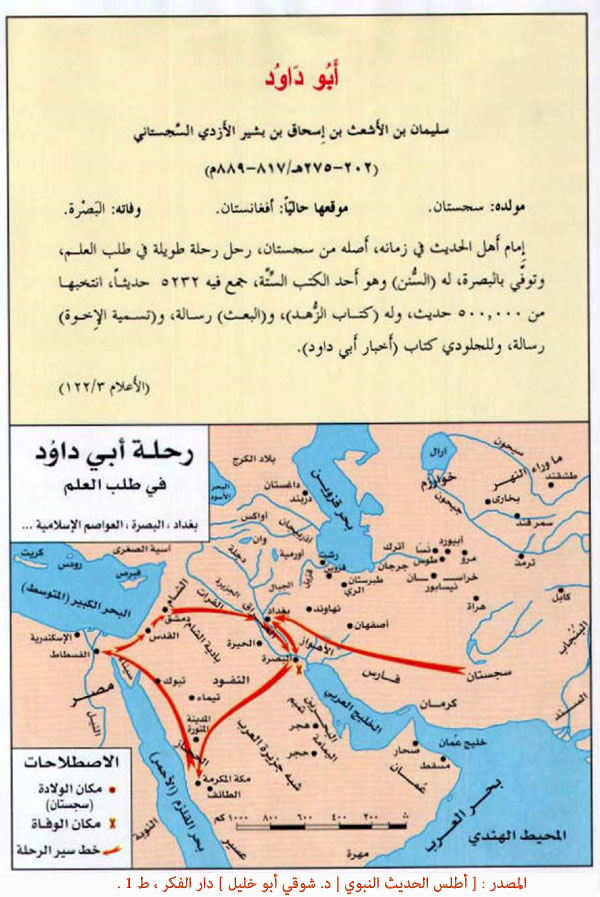
His association with Sistan (also known as Sijistan) is due to his residence there. This region is located between Sindh and Herat, and is adjacent to Kandahar (Afghanistan).
Travels for the Acquisition and Narration of Hadith
He traveled to major centers of Islamic knowledge for the purpose of acquiring and narrating Hadith. These included Egypt, Syria, the Hijaz (Makkah and Madinah), Baghdad, Jazirah, Basra, and Khorasan, among others. He visited Baghdad multiple times and benefited from the hadith scholars of cities like Nishapur, Marw, and Isfahan.
Teachers and Hadith Scholars
He studied under more than 300 hadith teachers and scholars. Some of the renowned among them are:
- ➊ Ahmad ibn Hanbal
- ➋ Ishaq ibn Rahwayh
- ➌ Abu Thawr
- ➍ Yahya ibn Ma'in
- ➎ Abu Bakr ibn Abi Shaybah
- ➏ Uthman ibn Abi Shaybah
- ➐ Sa'id ibn Mansur
- ➑ Sulayman ibn Harb
- ➒ Sulayman ibn Abd al-Rahman al-Dimashqi
- ➓ Shuja' ibn Mukhlid
- ⓫ Muhammad ibn Bashshar Bandār al-Basri
- ⓬ Muhammad ibn Sabbah Nizzar al-Dulabi
- ⓭ Muhammad ibn Minhal
- ⓮ Musaddad ibn Musarhad
- ⓯ Qanabi and many others.
Hadith Scholars Who Studied Under Imam Abu Dawood
Many scholars of Hadith had the honor of studying under Imam Abu Dawood. Among them, the following are notable narrators of his Sunan:
- ➊ Abu ‘Amr Ahmad ibn ‘Ali ibn Hasan al-Basri
- ➋ Abu ‘Ali Muhammad ibn Ahmad ibn ‘Amr al-Lu’lu’i (d. 333 AH)
- ➌ Abu al-Tayyib Ahmad ibn Ibrahim al-Ashnani al-Baghdadi
- ➍ Abu Sa‘id Ahmad ibn Muhammad ibn Sa‘id ibn Ziyad al-A‘rabi (d. 340 AH)
- ➎ Abu Bakr Muhammad ibn ‘Abd al-Razzaq ibn Dassah (d. 346 AH)
- ➏ Abu al-Hasan ‘Ali ibn al-Hasan ibn al-‘Abd al-Ansari (d. 328 AH)
- ➐ Abu ‘Isa Ishaq ibn Musa ibn Sa‘id al-Ramli al-Warraq (d. 320 AH)
- ➑ Abu Asamah Muhammad ibn ‘Abd al-Malik ibn Yazid al-Rawwas
- ➒ Abu Salim Muhammad ibn Sa‘id al-Jaludi
Narrators of Imam Abu Dawood’s Other Works
- ➊ Abu ‘Abdullah Muhammad ibn Ahmad al-Basri
- ➋ Abu Bakr Ahmad ibn Sulayman al-Najjad
- ➌ Isma‘il ibn Muhammad al-Saffar
- ➍ Abu ‘Ubayd Muhammad ibn ‘Ali al-Aajuri
Other Prominent Scholars Among His Students
- ➊ His son, Abu Bakr
- ➋ Abu ‘Awanah Ya‘qub ibn Ishaq al-Isfaraini
- ➌ Harb ibn Isma‘il al-Kirmani
- ➍ Zakariya al-Saji
- ➎ Abu Bakr Muhammad ibn Khallal
- ➏ Ahmad ibn Yasin al-Harawi and others
Authors of Sihah Sittah Who Studied Under Him
- ➊ Imam al-Tirmidhi
- ➋ Imam al-Nasa’i
Both Imam Tirmidhi and Imam Nasa’i were among those who studied under Imam Abu Dawood. Even his own teacher, Imam Ahmad ibn Hanbal, narrated the Hadith of ‘Atirah from him.
His Status in Hadith Memorization
Imam Abu Dawood held a distinguished status among the memorizers of hadith. ★ Abu Hatim: He stated, “He was among the leading Imams of the world in terms of memorization.” [Tahdhib al-Kamal 11/365] ★ Muhammad ibn Makhlad: He said, “Abu Dawood used to revise a hundred thousand hadiths thoroughly. And when he compiled his Sunan, all the scholars of his time acknowledged his memorization and scholarly excellence.” [Tahdhib al-Kamal 11/365] ★ Imam Nawawi: He remarked, “The majority of the scholars of Islam acknowledged the perfection of his memorization.”
Expertise in Hadith Defects
He was endowed with a profound mastery in the field of ‘Ilal (hidden defects in hadith), as acknowledged by distinguished scholars. His critical insight and power of discernment were unanimously recognized by the leading authorities in the discipline.
Statement by Ahmad ibn Muhammad ibn Yasin: Ahmad ibn Muhammad ibn Yasin al-Harawi said: “Abu Dawood was among the preservers of the Prophetic Hadith and the sciences of chains and their hidden defects. He held a lofty rank in worship, chastity, righteousness, and piety.” [Siyar 13/211, Tahdhib al-Kamal 11/365]
Statement by Abu Hatim ibn Hibban: Abu Hatim ibn Hibban stated: “Abu Dawood was one of the imams of the world in jurisprudence, knowledge, memorization, worship, piety, and mastery. He undertook the collection, organization, and composition of hadith, and defended the Sunan.” [Siyar 13/212, Tahdhib al-Tahdhib 4/172]
Statement by Hafiz Ibn Mandah: Hafiz Ibn Mandah remarked: “There are four individuals who specialized in the verification of hadiths — whether weak or sound, flawed or authentic — they are: al-Bukhari, Muslim, followed by Abu Dawood and al-Nasa’i.” [Shurut Ibn Mandah, Siyar 13/212, Tahdhib al-Kamal 11/365]
Statement by Muslim ibn Qasim:
Muslim ibn Qasim, mentioning his piety and God-consciousness, says: "He was trustworthy and ascetic, an expert in Hadith, and the leading scholar of this discipline in his time."
Statement by Hafiz Abu Bakr al-Khallal:
Hafiz Abu Bakr al-Khallal says: "Imam Abu Dawood was the leading Imam of his era. In his time, there was no one superior to him in recognizing the sources of knowledge, understanding the locations of Hadith, and he was unmatched in his piety and God-consciousness." [Tahdhib al-Kamal 11/364]
Statement by Abu Hatim ibn Hibban and Ahmad ibn Muhammad ibn Yasin al-Harawi:
Similarly, Abu Hatim ibn Hibban and Ahmad ibn Muhammad ibn Yasin al-Harawi, among others, have also specifically highlighted his piety and devotion.
An Illustration of the Imam’s Piety and Precaution:
One clear example of the Imam’s piety and caution is that he used to keep one sleeve of his garment wide and the other narrow. When asked about this, he replied: "I keep one sleeve wide so I can store parts of my books in it, while there is no need to make the other one wide."
This act reflects not only his piety and God-consciousness but also his scrupulousness in Hadith transmission and narration.
Recognition of Abu Dawood’s Eminence in Hadith Scholarship:
Imam al-Hakim: Imam al-Hakim said: “Abu Dawood was the undisputed leader of Ahl al-Hadith of his time.” [Al-Siyar 13/212]
‘Allan ibn ‘Abd al-Samad: ‘Allan ibn ‘Abd al-Samad opined: “He was a champion in the field of Hadith.” [Al-Siyar 13/212]
Hafiz Muhammad ibn Ishaq al-Saghani and Ibrahim al-Harbi: Hafiz Muhammad ibn Ishaq al-Saghani and Ibrahim al-Harbi expressed his mastery in Hadith in these words: “Hadith was made as soft and easy for Abu Dawood as iron was made soft for Dawood (peace be upon him).” [Al-Siyar 13/212–213, Tahdhib al-Tahdhib 4/172]
Musa ibn Harun: Musa ibn Harun said: “Abu Dawood was created for the service of Hadith in this world and to reside in Paradise in the Hereafter.” [Al-Siyar 13/212]
He also said: “I have never seen a person better than Abu Dawood.” [Al-Siyar 13/213]
Imam Abu Dawood’s Rank in Fiqh and Ijtihad
Just as Imam Abu Dawood held a leading position in Hadith, he also had a distinguished status in Fiqh and Ijtihad. Due to his deep juristic insight and profound understanding, some scholars ranked him second only to Imam Bukhari in the field of jurisprudence. It has been written that after Imam Bukhari, the highest rank belongs to Imam Abu Dawood, and all the biographers and compilers of scholars’ classes have mentioned this quality of his.
This inclination and insight of his can be clearly understood from the fact that he restricted his book “Kitab al-Sunan” solely to the compilation and arrangement of legal rulings and issues.
SB Imam Abu Hatim: EB Imam Abu Hatim considers him an Imam of Fiqh.
SB Imam Abu Ishaq Shirazi: EB Imam Abu Ishaq Shirazi counted only Imam Abu Dawood among the authors of the six canonical books in the ranks of jurists (fuqaha), and this distinction was granted to him due to his deep juristic perception and refined fiqhi taste.
Abu Ishaq al-Shirazi
Abu Ishaq al-Shirazi, while mentioning Imam Abu Dawud, associated him with the Hanbali school. He is also mentioned in the "Tabaqat al-Hanabilah". Some scholars have listed him as a Shafi‘i, but this is merely a pedagogical association. This misunderstanding likely arose due to the considerable agreement between Imam Ahmad ibn Hanbal and Imam al-Shafi‘i on most issues.
Nawab Siddiq Hasan
Nawab Siddiq Hasan, quoting Hafiz Ibn Hazm, states: “After those earlier scholars came al-Bukhari, Muslim, Abu Dawud, and al-Nasa’i. None of them adhered to the opinions of any previous Imam. Rather, each of them refrained from blind following (taqlid) and criticized it.”
Hafiz al-Dhahabi
While commenting on Abu Dawud's vast knowledge and leadership in jurisprudence and hadith, Hafiz al-Dhahabi says: "Abu Dawud was among the great jurists in addition to being a leader in hadith and its sciences. His book 'al-Sunan' is a testament to this. He was one of the chosen disciples of Imam Ahmad. He consistently attended Imam Ahmad's gatherings for a long time. He was questioned on complex issues of usul (fundamentals) and furu' (subsidiaries). In his adherence to the Sunnah, submission before it, and avoidance of delving into complex philosophical discourse, he followed the way of the Salaf." [Siyar A‘lam al-Nubala’ 13/215]
Allama Tahir al-Jaza’iri
Similarly, the statement of Allama Tahir al-Jaza’iri also negates the notion that Imam Abu Dawud was a follower (muqallid) of another Imam. He says: “As for al-Bukhari and Abu Dawud, they were both Imams in jurisprudence and were among the people of ijtihad (independent reasoning).”
Children
Among his offspring, only one son is mentioned— the hadith scholar Abu Bakr Abdullah.
Demise
The Imam passed away on Friday, the 16th of Shawwal in the year 275 AH, at the age of 73. May Allah have abundant mercy on him.
