

Imam Ibn Mājah
Imam Ibn Mājah (may Allah have mercy on him) is among the shining stars of the science of Hadith who still illuminate the scholarly skies. He is counted among the most esteemed and prominent scholars of Hadith. He also enjoys the honour of being listed among the six eminent Imams whose Hadith collections have been universally accepted by the Muslim Ummah. Like other great Imams, Imam Ibn Mājah earned great renown for his service to Hadith and played a vital role in its compilation. He spent his entire life nurturing the garden of Hadith. To compile and preserve the sayings of the Prophet ﷺ, he journeyed to various lands, learning from the great Hadith masters and scholars of his time. He not only filled his own heart with the precious pearls of Prophetic tradition but also preserved them for future generations. Imam Ibn Mājah was a great scholar of Hadith, Tafsir, and history. Especially in the field of Hadith, he was considered a memoriser and a master of the discipline. For this reason, critics and scholars such as Hafiz Shams al-Dīn al-Dhahabi, Hafiz Ibn Hajar (may Allah have mercy on them), and others acknowledged his leadership in Hadith studies, his elevated status, vast insight, memorisation skills, and reliability. They praised his scholarly and technical contributions.
Abu Abdullah Muhammad bin Yazid bin Abdullah al-Rab'i al-Qazwini, known as Ibn Majah
He was of non-Arab (Ajami) origin. “Rab’i” is a nisbah (affiliation) to Rabi‘ah and is considered a nisbat al-wala’ (attribution through allegiance). Due to his affiliation with the region of Qazvin (in Iran), he is also known as “al-Qazwini.”
He is widely known by the name “Ibn Majah.” Regarding this, Allama al-Zabidi (رحمه الله) in his work *Taj al-‘Arus* mentioned various opinions. One view is that “Majah” was the name of his mother. Imam al-Nawawi (رحمه الله) also gave preference to this opinion, and Shah Abdul Aziz Dehlavi (رحمه الله) narrated the same in *Bustān al-Muhaddithīn*: “Wa sahih an ast ke Majah (with a softened jim) madar-e-u bud” — meaning, the correct view is that Majah was his mother. This is why the title “Ibn Majah” is distinguished with an “alif.” However, it should be noted that “Ibn Majah” refers to Muhammad, not to Abdullah. According to some scholars, “Majah” was the title of his honorable father. Hafiz Ibn Hajar (رحمه الله) also preferred this view. And Allah knows best (وَاللهُ أَعْلَمُ).
Birth and Early Life of Imam Ibn Mājah
He was born in 209 AH, corresponding to 824 CE. Yāqūt ibn ʿAbdullāh al-Ḥamawī reports from Jaʿfar ibn Idrīs in his “Tārīkh al-Qazwīn” that: “Abū ʿAbdullāh died in 273 AH, and his statement is: I was born in the year 209 AH.” Although the details of Imam Ibn Mājah’s childhood remain veiled in obscurity, it appears that, following the common custom of the time, he completed his basic education and then turned his attention to the science of Hadith. His initial studies in this discipline began in his own city, which by that time had become a flourishing center of Hadith scholarship.
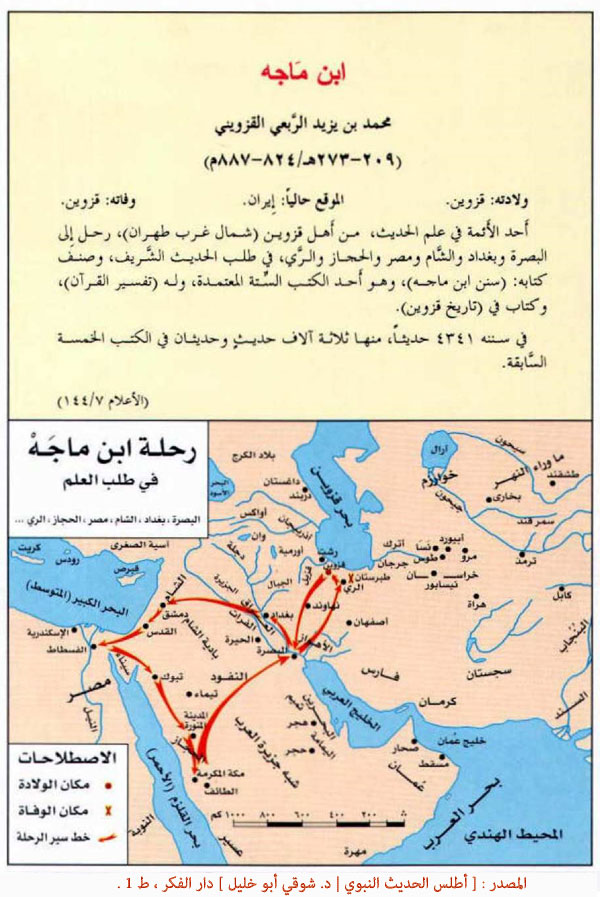
After gaining knowledge from the scholars of his hometown and surrounding areas, in the year 230 AH, when he was approximately 21 or 22 years old, he set out on a journey to other lands in search of Hadith. Ibn al-Jawzi writes in "Al-Muntazam": "Then he traveled to the cities of Khurasan, Iraq, Hijaz, Egypt, and Syria, and regularly attended the gatherings of the Hadith scholars."
Imam Hanbali رحمه الله writes: "He traveled to both Iraqs (Kufa and Basra), Egypt, and Syria." In addition to this, he also benefited from the scholars of Makkah and Madinah, and then journeyed to Baghdad, which, according to Imam Dhahabi رحمه الله, was "the abode of high isnad (chains of narration), preservation, and the center of the caliphate and knowledge."
Not only that, he also pursued his scholarly passion and dedication to the collection and documentation of Hadith by sitting before the leading Hadith authorities in Damascus, Homs, Egypt, Isfahan, Asqalan, and Nishapur. This makes it clear how much effort and striving Imam Ibn Majah رحمه الله undertook for acquiring the Hadith of the Prophet ﷺ. He reached almost all major centers of knowledge of his time, benefited from the gatherings of the senior scholars of Hadith, and enlightened his heart and mind with the Prophetic traditions.
Teachers of Imam Ibn Mājah
Imam Ibn Mājah (may Allah have mercy on him) had the honour of studying under the great hadith scholars of his time, including scholars from Makkah, Madinah, and Qazwin. In Madinah, his teachers included: ➊ Ḥāfiẓ Ibn Muṣʿab al-Zubayrī, ➋ Aḥmad ibn Abū Bakr al-ʿAwfī, and ➌ Ḥāfiẓ Ibrāhīm ibn al-Mundhir. In Makkah, he benefited from: ➍ Ḥāfiẓ Julwānī Abū Muḥammad Ḥasan ibn ʿAlī al-Khallāl, ➎ Ḥāfiẓ Zubayr ibn Bakkār, the Qāḍī of Makkah, and ➏ Ḥāfiẓ Salamah ibn Shabīb, among others. Among the scholars of Qazwin were: ➐ ʿAmr ibn Rāfiʿ al-Bajlī, ➑ Ismāʿīl ibn Tawbah, and ➒ Muḥammad ibn Abū Khālid al-Qazwīnī. In addition to these, other notable teachers include: ➓ Jabbārah ibn al-Mughlis, ⓫ Abū Bakr ibn Abī Shaybah, ⓬ Naṣr ibn ʿAlī al-Jahḍamī, ⓭ Muḥammad ibn Yaḥyá al-Naysābūrī, ⓮ Abū Bakr ibn Khallād al-Bāhilī, ⓯ Muḥammad ibn Bashshār, ⓰ ʿAlī ibn Muḥammad al-Ṭanāfisī, and ⓱ ʿAlī ibn Mundhir.
Students of Imam Ibn Majah (رحمه الله)
Imam Ibn Majah (رحمه الله) had a long list of students who benefited from his knowledge. His students were not limited to Qazvin alone, but were spread across other scholarly centers such as Hamadan, Isfahan, Baghdad, and various parts of the world. Notable among them are: Ali bin Sa'id bin Abdullah al-Fallani, Ibrahim bin Dinar al-Jurashi, Ahmad bin Ibrahim al-Qazwini, Hafiz Abu Ya'la al-Khalili, and Abu Amr Ahmad bin Muhammad bin Hakim al-Madani al-Isfahani.
Notable Narrators of Sunan Ibn Majah
Among the close students of Imam Ibn Majah (رحمه الله) who had the honor of narrating *Sunan Ibn Majah*, the following are noteworthy: Abu al-Hasan al-Qattan, Sulayman bin Yazid, Abu Ja'far Muhammad bin 'Isa, and Abu Bakr Hamid al-Abhari.
Scholarly Recognition of Imam Ibn Majah
Imam Ibn Majah (رحمه الله) was a great hadith scholar, Quran commentator, and historian of his time. Scholars and experts of every era have acknowledged his excellence in the field of Hadith.
Imam al-Dhahabi: Imam al-Dhahabi (رحمه الله) said: “Imam Ibn Majah was a hadith master (Hafiz), a critic of the discipline, truthful, and possessed vast knowledge.” In Tadhkirat al-Huffaz, he also wrote: “He was a great Hafiz and among the hadith scholars and commentators of Qazvin.”
Abu Ya'la al-Khalili: He said: “He was very reliable, a valid authority, and well-versed in hadith sciences.”
Allama al-Sindi: He said: “He was among the eminent Imams of the Muslims, righteous, and unanimously considered trustworthy.”
Authorship and Works of Imam Ibn Majah
After acquiring knowledge, Imam Ibn Majah (may Allah have mercy on him) also took great interest in writing and compilation. As part of his lasting contributions, he left behind three major works, known as al-Baqiyat al-Salihat, which are as follows:
➊ As-Sunan: This is considered one of the six authentic books of Hadith (As-Sihah as-Sittah), and it holds the sixth position in terms of rank among them.
➋ At-Tafsir: This was a very comprehensive commentary in which he compiled Hadiths, sayings of the Companions, and the Followers, all with chains of transmission. Imam Suyuti (may Allah have mercy on him) counted the Tafsir of Ibn Abi Hatim and the Tafsir of Ibn Majah among the great commentaries, second only to Tafsir at-Tabari. Similarly, in *Al-Bidayah*, Imam Ibn Kathir also referred to it as a very extensive Tafsir.
➌ At-Tarikh: This historical work is a testament to his scholarly greatness and reflects his depth of knowledge and expertise. Imam Ibn Kathir called it a "Complete History", and the renowned historian Ibn Khallikan referred to it as a "Beautiful History". Unfortunately, both of the latter two books are now lost to time.
Death of Imam Ibn Majah
On Monday, the 22nd of Ramadan 273 AH, corresponding to 887 CE, at the age of 64, he answered the call of his Lord and departed from this mortal world to the eternal abode. “O Allah, forgive him, have mercy on him, grant him well-being, and pardon him.”
His brothers, Abu Bakr and Abdullah, along with his son Abdullah, took a leading role in his funeral arrangements. His funeral prayer was led by his brother Abdullah.
Numerous poets composed heart-rending elegies upon his sorrowful demise. One such verse by Muhammad bin Aswad Qazwini was quoted by Hafiz Ibn Hajar in Tahdhib al-Tahdhib: “Indeed, the death of Ibn Majah has weakened the foundations of the edifice of knowledge and shaken its pillars.”
