

Your Name and Lineage
Your name is Ahmad and your kunyah is Abu Abdur-Rahman. Your lineage is as follows: Ahmad bin Shu'ayb bin Ali bin Sinan bin Bahr bin Dinar bin Nasa'i al-Khurasani. [Al-Tadhkirah: 2/241, Tabaqat al-Shafi‘iyyah 2/83]
Date of Birth Disagreement
There is a difference of opinion regarding his year of birth. Some have mentioned 214 AH while others have stated 215 AH. [Al-Tadhkirah, Al-Tahdhib, Tabaqat al-Shafi‘iyyah]
It is reported directly from Imam al-Nasa’i himself that he was born around 215 AH, as he undertook his first journey to Qutaybah ibn Sa‘id in 230 AH and stayed with him for one year and two months. [Tahdhib al-Kamal 1/338, Siyar A‘lam al-Nubala 14/125]
Statement by Ibn Yunus al-Misri
Ibn Yunus al-Misri says: Imam al-Nasa’i came to Egypt long ago, where he wrote hadiths from scholars and students wrote hadiths from him. He was an imam of hadith, trustworthy, precise, and a hadith memorizer. He departed from Egypt in the month of Dhu al-Qa‘dah 302 AH and passed away in Palestine on a Monday, the 13th of Safar 303 AH. [Tahdhib al-Kamal, Tadhkirat al-Huffaz 2/701, Siyar 14/133, Al-Hittah fi Dhikr al-Sihah al-Sittah 458]
Statement by Imam al-Dhahabi
Imam al-Dhahabi states in *Duwal al-Islam*: Imam al-Nasa’i was 88 years old. This estimation is based on the birth year of 215 AH. Most scholars have stated that Imam al-Nasa’i lived to be 88. [Al-Bidayah wa al-Nihayah 11/124, Tawdih al-Mushtabih by Ibn Nasir al-Din al-Dimashqi 5/18, Tahdhib al-Tahdhib 1/36–37, Shadharāt al-Dhahab]
Clarification on Incorrect Date
This detail clarifies that some individuals have mentioned 225 AH as the year of Imam al-Nasa’i’s birth, which is not accurate. For instance, while Ibn al-‘Imad mentioned his death as 303 AH, he also stated: “He was 88 years old.” Therefore, the claim by some historians that al-Nasa’i was born in 225 AH is incorrect. [Shadharāt al-Dhahab]
Birth and Origin
He was born in the renowned city of Nasa in the region of Khorasan, which is pronounced with a fathah on the letters "noon" and "seen," and a kasrah on the hamzah with a prolonged sound. At times, Arabs would change the hamzah to a "waw" when attributing, and say "Nasawi," which is also linguistically appropriate, though the more famous usage is "Nasa’i." It should be noted, however, that Imam al-Nasa’i later settled in Egypt.
Imam al-Nasa'i's Journey for Knowledge
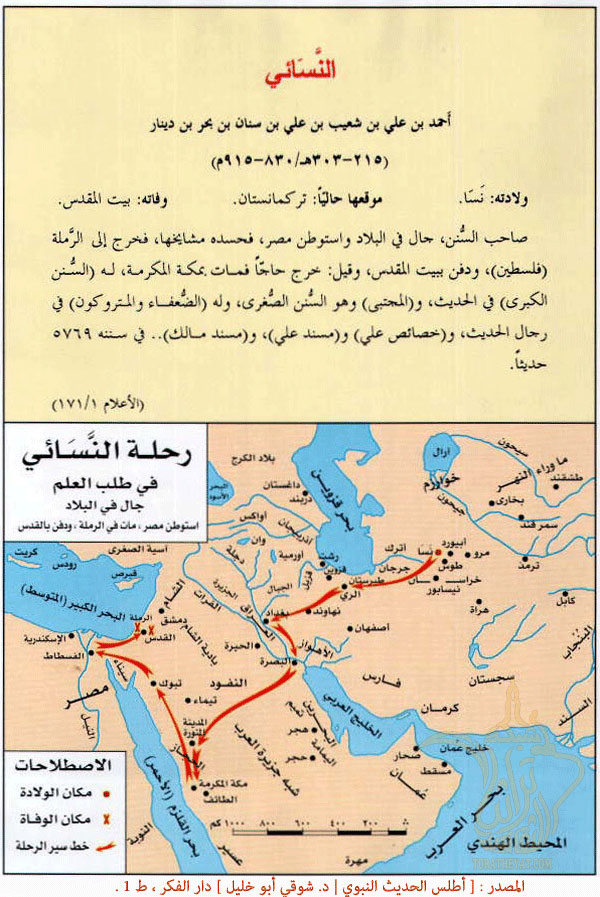
Historians have recorded his scholarly journeys. Hafiz Ibn Kathir writes about his scholarly travels: "Rahala ilā al-āfāq washtaghala bismā‘ al-ḥadīth wal-ijtima‘ bil-aʼimmah al-ḥudhāq" [al-Bidayah: 123] — meaning, “Imam al-Nasa'i travelled far and wide, dedicated himself to the hearing of hadith, and met with the expert scholars (imams).”
Teachers and Narrators from Whom Imam al-Nasa'i Acquired Hadith
Imam al-Nasa'i acquired the knowledge of hadith from a large number of scholars. Hafiz Ibn Hajar states that Imam al-Nasa'i heard hadiths from countless individuals. [Tahdhib al-Tahdhib]
A few prominent scholars and hadith narrators are listed below: ➊ Ibrahim ibn Ya‘qub al-Jawzajani ➋ Abu Dawud Sulayman ibn al-Ash‘ath al-Sijistani ➌ Ahmad ibn Bakkar ➍ Ahmad ibn Hanbal ➎ Ishaq ibn Rahuyah ➏ al-Harith ibn Miskin ➐ Ziyad ibn Yahya al-Hassai al-Nakari al-Basri ➑ ‘Abbas ibn ‘Abd al-‘Azim al-‘Anbari ➒ ‘Abdullah ibn Ahmad ibn Hanbal ➓ ‘Abdullah ibn Sa‘id al-Kindi ⓫ ‘Ali ibn Hujr ⓬ ‘Ali ibn Khushram ⓭ ‘Amr ibn ‘Ali al-Fallas ⓮ ‘Amr ibn Zurarah ⓯ Qutaybah ibn Sa‘id ⓰ Muhammad ibn Isma‘il al-Bukhari.
Clarification: According to Hafiz al-Mizzi's research, Imam al-Nasa'i did not directly hear hadith from Imam al-Bukhari, rather he narrated from him through intermediaries. [Tahdhib al-Kamal 24/437] However, the correct and researched opinion is that Imam al-Nasa'i was indeed a student of Imam al-Bukhari. Hafiz Ibn Hajar wrote in the introduction of Fath al-Bari that among the major hadith masters who narrated hadiths from Bukhari are Muslim, Nasa'i, Tirmidhi, Abu al-Fadl Ahmad ibn Salamah, and Ibn Khuzaymah. [p. 492] He further clarified at the end of Bukhari's entry in Tahdhib al-Tahdhib [9/55] and also in the biography of Muhammad ibn Isma‘il from Hafs ibn ‘Umar ibn al-Harith [9/63] that without any doubt, Imam al-Bukhari was the teacher of al-Nasa'i, and the opinion of Hafiz al-Mizzi is not correct. [See also: Siyar A‘lam al-Nubala’ 2/748]
⓱ Muhammad ibn al-Muthanna ⓲ Muhammad ibn Bashar ⓳ Muhammad ‘Abd al-A‘la ⓴ Ya‘qub ibn Ibrahim al-Dawraqi [21] Hisham ibn ‘Ammar [22] Hannad ibn al-Sari were especially noteworthy.
Scholars and Students of Hadith Narrating from Imam al-Nasa’i
A large number of scholars and hadith transmitters acquired knowledge from Imam al-Nasa’i and narrated hadiths from him. Regarding them, Hafiz Ibn Hajar states that they are innumerable. [Tahdhib al-Tahdhib]
Imam al-Nasa’i was renowned for his leadership in religious sciences and was an advanced Shaykh al-Hadith. Students would flock to him not only to benefit from his knowledge and expertise but also to acquire a higher chain of narration (isnad), since he had narrated hadiths from Qutaybah ibn Sa‘id and others of his generation. By the end of the 3rd century and the beginning of the 4th century AH, no other narrator remained with such a high chain except Imam al-Nasa’i. This is why narrators were especially eager to receive hadiths from him. The list of his renowned student narrators is as follows.
Transmitters of Sunan al-Nasa’i
Among the students of Imam al-Nasa’i who narrated his Sunan, Hafiz Ibn Hajar mentioned ten notable narrators, as listed below:
1. ‘Abd al-Karim ibn Ahmad ibn Shu‘ayb al-Nasa’i (d. 344 AH):
‘Abdullah ibn Muhammad ibn Asad al-Juhani, Ayyub ibn Husayn al-Qadi al-Thaghar, and Khasib ibn ‘Abdullah narrated the Sunan from him. Ibn Khayr states, “Abu Muhammad ibn Asad possessed the Kitab al-Tibb (in two volumes), and he alone narrated it from Abu Musa ‘Abd al-Karim ibn Ahmad ibn Shu‘ayb al-Nasa’i.” [Fihrist Ibn Khayr, p. 113; Tahdhib al-Tahdhib 1/37]
He also mentions that Abu ‘Ali al-Ghassani said: “The narration of al-Mujtaba from al-Nasa’i was transmitted by his son ‘Abd al-Karim and Walid ibn al-Qasim al-Sufi.” [Fihrist Ibn Khayr, pp. 116–117]
2. Abu Bakr Ahmad ibn Muhammad ibn Ishaq ibn al-Sunni al-Dinawari (d. 364 AH):
Hafiz Ibn Hajar listed him among the transmitters of Sunan al-Sughra. However, Ibn Khayr does not mention him in his list of transmitters. He is a narrator of al-Mujtaba, the abridged version of al-Nasa’i’s Sunan. [Siyar A‘lam al-Nubala’, 16/255]
The earliest known manuscripts of Sunan al-Sughra come through the chain of Ibn al-Sunni. It is firmly established that Imam al-Nasa’i himself authored Sunan al-Sughra (al-Mujtaba). Ibn al-Sunni is merely a narrator. Some have mistakenly attributed authorship to him due to certain additions in his narration, but scholars agree that it is common for narrators to insert supplementary material from their teachers. For example, there are additions by ‘Abdullah ibn Ahmad and al-Qati‘i in Musnad Ahmad and Fada’il al-Sahabah, and by Abu al-Hasan al-Qattan in Sunan Ibn Majah.
A strong proof that Sunan al-Sughra is by al-Nasa’i is that it contains several ahadith not found in Sunan al-Kubra.
3. Abu ‘Ali al-Hasan ibn al-Khidr al-Asyuti (d. 361 AH):
Abu al-Hasan ‘Ali ibn Muhammad ibn Khalaf al-Qabisi and Abu al-Qasim ‘Abd al-Rahman ibn Muhammad ibn ‘Ali al-Idfawi narrated the Sunan from him. [Fihrist Ibn Khayr, p. 112]
4. Hasan ibn Rashiq Abu Muhammad al-‘Askari (d. 370 AH):
Ahmad ibn ‘Abd al-Wahid ibn al-Fadl Abu al-Barakat al-Farra’ and Abu al-Qasim Hasan ibn Muhammad al-Anbari narrated the Sunan from him.
5. Abu al-Qasim Hamzah ibn Muhammad ibn ‘Ali al-Kinani al-Misri al-Hafiz (d. 357 AH), also known as Sahib Majlis al-Bitaqah:
Seven narrators transmitted the Sunan from him.
Ibn Khayr mentions that the manuscript of Abu Muhammad ‘Abdullah ibn Muhammad ibn Asad al-Juhani includes some books not found in the narration of Abu Muhammad Usayli. These include Manaqib al-Sahabah (4 volumes), Kitab al-Nu‘ut (1 volume), Kitab al-Bay‘ah (1 volume), Kitab Thawab al-Qur’an (1 volume), Kitab al-Ta‘bir (1 volume), and Kitab al-Tafsir (5 volumes). These books were transmitted from Qadi Hamzah by Abu ‘Abdullah Muhammad ibn Ahmad ibn Yahya ibn Mufarrij and Abu al-Qasim Ahmad ibn Muhammad ibn Yusuf al-Ma‘afiri—both companions of Muhammad ibn Asad. However, neither Muhammad ibn Qasim nor Abu Bakr ibn al-Ahmar narrated them, except for Kitab al-Isti‘adhah and Fada’il ‘Ali ibn Abi Talib found with Ibn Qasim.
Ibn Khayr further adds that apart from this compilation, he also found Kitab al-Iman and Kitab al-Sulh written in the handwriting of Abu Muhammad ibn Yarbu‘. The narration chain for Kitab al-Iman is: Abu ‘Ali Husayn ibn Muhammad al-Ghassani → Abu ‘Umar ibn ‘Abd al-Barr → Abu al-Qasim Ahmad ibn Fath al-Tajir → Hamzah ibn Muhammad al-Kinani. Abu ‘Ali al-Ghassani also narrates it through the following chain: Abu Marwan ‘Abd al-Malik ibn Ziyadat Allah al-Tamimi → Abu Ishaq Ibrahim ibn Sa‘id ibn ‘Abdullah al-Habbal → Abu al-Faraj Muhammad ibn ‘Umar al-Sudafi → Hamzah al-Kinani in Rajab 354 AH, who said: “Abu ‘Abd al-Rahman al-Nasa’i narrated to us by direct recitation in his own words.” [Fihrist Ibn Khayr, p. 115]
Hafiz al-Mizzi mentions in Tuhfat al-Ashraf multiple times that Kitab al-Mawa‘izh was exclusively narrated by Abu al-Qasim Hamzah al-Kinani.
➏ Ibn Haywayh: Abul Hasan Muhammad bin Abdul Karim bin Zakariya bin Haywayh al-Naysapuri al-Misri (d. 366 AH): Abul Hasan al-Qabisi the jurist, Abul Hasan Ali bin Munir al-Khallal, and Abul Hasan Ali bin Rabee’ah al-Bazzar narrated the Sunan from him. [Fihrist Ibn Khayr 115] Hafiz al-Mizzi relied on the narration of Ibn Haywayh in *Tuhfat al-Ashraf*.
➐ Muhammad bin Mu'awiyah bin al-Ahmar al-Andalusi al-Qurtubi (d. 358 AH): After hearing the *Sunan al-Kubra*, he carried it to al-Andalus, and people heard this book from him. The currently published edition of *Sunan al-Kubra* is based on the narration of Ibn al-Ahmar and Ibn Sayyar. Those who narrated Sunan from Ibn al-Ahmar include: ① Abu al-Walid Yunus bin Abdullah bin Mughith al-Qadi ② Sa'id bin Muhammad Abu Uthman al-Qallas ③ Muhammad bin Marwan bin Zahr Abu Bakr al-Ayyadi ④ Abdullah bin Rabee’ bin Bannus Abu Muhammad [Fihrist Ibn Khayr 110]
➑ Muhammad bin Qasim bin Muhammad bin Sayyar al-Qurtubi al-Andalusi, Abu Abdullah (d. 327 AH): Abu Muhammad Abdullah bin Muhammad bin Ali al-Baji and Abu Bakr Abbas bin Asbagh al-Hijazi narrated the Sunan from him. Ibn Khayr says: Muhammad bin Qasim and Abu Bakr bin al-Ahmar heard from the same copy. In Muhammad bin Qasim’s version were included the books *Fada'il Ali wa Khawasih* and *Kitab al-Isti'adhah*, which were not present in the copy of Ibn al-Ahmar. [Fihrist Ibn Khayr 111, 112; Tahdhib al-Kamal 1/37]
➒ Ali bin Abi Ja’far Ahmad bin Muhammad bin Sallamah, Abu al-Hasan al-Tahawi (d. 351 AH) [Tahdhib al-Tahdhib 1/37]
➓ Abu Bakr Ahmad bin Muhammad bin al-Muhandis (d. 385 AH): All of these are narrators who transmitted the *Sunan* from al-Nasa’i. [Tahdhib al-Tahdhib 1/37] Abdullah bin Muhammad bin Abid al-Mu’afiri narrated the *Sunan* from Ibn al-Muhandis. [Fihrist Ibn Khayr 115] Hafiz Ibn Hajar mentioned these ten narrators in *Tahdhib al-Tahdhib*, but Hafiz al-Dhahabi says: Whoever said that Ibn al-Muhandis heard from al-Nasa’i was mistaken. [Siyar A‘lam al-Nubala 462]
⓫ Abu al-Qasim Mas'ud bin Ali bin Marwan bin al-Fadl al-Bajjani: During Hajj, he learned from al-Nasa’i in Egypt and narrated the *Sunan*. [Tarikh Ibn al-Faradi, entry 2146; *al-Lubab fi al-Ansab* by Ibn al-Athir, entry: al-Bajjani; *al-Mushtabih* by al-Dhahabi, p. 51; *Tawdih al-Mushtabih* by Ibn Nasir al-Din al-Dimashqi 1/370–371; Hashiyah Tahdhib al-Kamal 1/333]
⓬ Abu Hurayrah bin Abi al-‘Isam: Ahmad bin Abdullah bin al-Hasan bin Ali al-‘Adawi: Abdullah bin Muhammad bin Asad al-Juhani narrated the *Sunan* from him. [Fihrist Ibn Khayr 114]
⓭ Ibn Abi al-Tammam: Ahmad bin Muhammad bin Uthman bin Abdul Wahhab bin ‘Urfa bin Abi al-Tammam, Imam of the Grand Mosque in Egypt: Abu Muhammad al-Asili and Hafiz Abu al-Qasim Khalaf bin al-Qasim narrated the *Sunan* from him. Ibn Khayr says: The narration of *Kitab al-Sulh* from *Sunan al-Nasa’i* is through Abu Ali al-Ghassani from Abu Shakir Abdul Wahid bin Muhammad bin Muhibb al-Asili, and Abu Ali narrates with the chain: Ibn Abd al-Barr from Abu al-Qasim Khalaf bin al-Qasim, and both al-Asili and Abu al-Qasim narrate from Abu al-Hasan Ibn ‘Urfa from al-Nasa’i. [Fihrist Ibn Khayr 113] It is to be noted that *Kitab al-Sulh* is not found in either *Sunan al-Sughra* or *al-Kubra*, and neither Hafiz al-Mizzi nor Hafiz Ibn Hajar referred to it.
⓮ Abu Ali Hasan bin Badr bin Abi Hilal: Abu al-Hasan Ali bin Muhammad bin Khalaf al-Qabisi narrated the *Sunan* from him. [Fihrist Ibn Khayr 112]
⓯ Abu Ahmad Husayn bin Ja'far bin Muhammad al-Zayyat: Khalaf bin Qasim bin Sahl al-Dabbagh al-Hafiz narrated the *Sunan* from him. [Fihrist Ibn Khayr 114]
⓰ Abu Muhammad Abdullah bin Hasan al-Misri [Tuhfat al-Ashraf 11131]
⓱ Abu al-Tayyib Muhammad bin Fadl bin Abbas [Tuhfat al-Ashraf 5318]
⓲ Abu al-Hasan Ali bin al-Hasan al-Jurjani [Tarikh Jurjan 317]
⓳ Walid bin al-Qasim al-Sufi: Ibn Khayr mentions in his *Fihrist* that Abu Ali al-Ghassani says: The *al-Mujtaba* was narrated from al-Nasa’i by his sons Abdul Karim and Walid bin al-Qasim al-Sufi. [Fihrist Ibn Khayr 116, 117]
Some additional renowned students are listed below:
➊ Abu al-Qasim Sulayman ibn Ahmad al-Tabarani
➋ Abu ‘Awanah Ya‘qub ibn Ishaq al-Isfarayini
➌ Abu Bishr al-Dulabi
➍ Abu Ja‘far Muhammad ibn ‘Amr al-‘Uqayli
➎ Ahmad ibn Muhammad ibn Sallamah Abu Ja‘far al-Tahawi
➏ Ibrahim ibn Muhammad ibn Salih
➐ Abu ‘Ali Husayn ibn Muhammad al-Naysaburi
➑ Abu Ahmad ‘Abdullah ibn ‘Adi al-Jurjani
➒ Abu Sa‘id ‘Abd al-Rahman ibn Ahmad ibn Yunus ibn ‘Abd al-A‘la al-Sudafi, the author of *Tarikh Misr* (History of Egypt)
➓ Muhammad ibn Sa‘d al-Sa‘di al-Bawardī
⓫ Abu ‘Abdullah Muhammad ibn Ya‘qub ibn Yusuf al-Shaybani, the hadith scholar known as al-Akhram
⓬ Mansur ibn Isma‘il al-Misri, the jurist.
⓬ Abu Bakr Muhammad ibn Ahmad ibn al-Haddad, the jurist.
The last-mentioned, Abu Bakr ibn al-Haddad, is someone who did not narrate from anyone other than Imam al-Nasa’i.
Imam al-Daraqutni said: “Ibn al-Haddad was a prolific narrator of hadith, but he did not narrate from anyone besides al-Nasa’i. He said, ‘I have made al-Nasa’i a proof between me and Allah, the Exalted.’”
[*Tabaqat al-Shafi‘iyyah* 2/113, *Tadhkirat al-Huffaz* 2/700, *al-Bidayah* 11/123]
Allah Granted Imam al-Nasa'i Exceptional Memory
Allah Almighty blessed Imam al-Nasa'i with extraordinary memorization power. Al-Dhahabi even ranked him higher than Imam Muslim in terms of hadith memorization.
SB Ibn Yunus al-Misri: EB Ibn Yunus al-Misri said: «كان النسائي إماما فى الحديث ثقة ثبتا حافظا» [Al-Bidayah 123] — “Al-Nasa'i was an Imam in hadith, trustworthy, reliable, and a hadith memorizer.”
SB al-Subki: EB Al-Subki said: «سألت شيخنا أبا عبدالله الذهبي الحافظ وسألته أيهما أحفظ مسلم بن الحجاج صاحب الصحيح أو النسائي فقال : النسائي» [Tabaqat al-Shafi'iyyah 2/84] — “I asked my teacher, the hadith scholar al-Hafiz al-Dhahabi, ‘Who has a better memory of hadith, Muslim ibn al-Hajjaj (compiler of Sahih Muslim) or al-Nasa'i?’ He replied: Al-Nasa'i.”
SB Hafiz al-Suyuti: EB Hafiz al-Suyuti said: «الحافظ أحد الحفاظ المتقنين» [Husn al-Muhadara 1/147] — “Al-Nasa'i was one of the highly proficient hadith memorisers.”
Imam al-Nasa'i's Practical Life and Piety
The practical lifestyle of Imam al-Nasa’i can be well understood from a statement by Muhammad ibn al-Muzhaffar, which al-Dhahabi quoted as follows: «I heard our scholars in Egypt describe al-Nasa’i’s devotion to worship both day and night. He went out for battle with the governor of Egypt and was praised for his dignity, his strict adherence to the established Sunnah in serving the Muslim cause, and his caution in avoiding the gatherings of the ruler who accompanied him.» [Tadhkirat al-Huffaz, Tahdhib al-Kamal 1/334]
Al-Dhahabi narrates: “I heard our teachers in Egypt say that al-Nasa’i was devoted to worship day and night. He accompanied the Egyptian governor in jihad, and gained fame for his dignity, sharp intellect, and practice of the established Sunnahs among Muslims. Although he traveled with the ruler, he stayed away from his assemblies.”
SB Ibn al-Athir in Jami' al-Usul: He says, there is no stronger proof of Imam al-Nasa’i’s scrupulousness and piety than this: when he received hadith from his teacher Harith ibn Miskin, he never used the common narration terms like "haddathana" (he narrated to us) or "akhbarana" (he informed us). Instead, he used the more careful phrase, “He was read to while I listened” (quri'a 'alayhi wa ana asma'). Harith ibn Miskin held a judicial post in Egypt and due to distance or formal issues, al-Nasa’i could not attend his study circle openly. So he would listen to the lessons secretly from outside, ensuring that Harith wouldn’t see him. Due to this caution, he did not use the usual narration formulas.
It is also said that Harith ibn Miskin was engaged in some governmental duties when al-Nasa’i visited him in an unusual outfit. People say he wore a long robe and a tall hat, which Harith disliked. Suspecting that he might be a government spy due to his unusual appearance, Harith didn’t allow him to attend his class. Thus, al-Nasa’i would sit by the door and listen to the reading from outside. This is why he refrained from using the narration terms “haddathana” and “akhbarana” when narrating from him. [Jami’ al-Usul 1/128]
It is also worth noting that Imam Abu Dawood used the same phrasing: “It was read to Harith ibn Miskin,” as seen in the final chapters of Kitab al-Tibb and in Kitab al-Sunnah under the chapter “Children of the Polytheists.”
Recognition of Imam al-Nasa'i's Scholarly and Religious Status
Scholars have acknowledged Imam al-Nasa'i's outstanding religious services, profound scholarship, and excellence in authorship, to such an extent that he was titled "Imam of the Muslims" and "Imam in the Science of Hadith." He was recognized as a leader in both religion and knowledge.
SB Muhammad ibn Sa’d al-Bawardhi: EB He said: “I mentioned Abu ‘Abd al-Rahman al-Nasa’i to Qasim Mutarraz, and he said: Al-Nasa’i is an Imam, or worthy of being called an Imam.” [Tahdhib al-Kamal 1/333]
SB Imam al-Hakim: EB He said: “I heard al-Daraqutni say many times: ‘Abu ‘Abd al-Rahman is ahead of all contemporaries known for this knowledge.’” [Ma‘rifah ‘Ulum al-Hadith 83, Taqyid 140, Tahdhib al-Kamal 1/334, Tadhkirah, Bidayah wa Nihayah 14/793, Siyar 14/131, Tabaqat al-Shafi‘iyyah]
◈ Al-Hakim also said: “I heard Abu ‘Ali Husayn ibn ‘Ali mention the names of four Imams of Islam, and the first among them was Abu ‘Abd al-Rahman al-Nasa’i.” [Ma‘rifah ‘Ulum al-Hadith 82, Tahdhib al-Kamal 1/333]
◈ He further narrates from Abu ‘Ali that he asked Abu ‘Abd al-Rahman al-Nasa’i something, acknowledging him as one of the Imams of Islam. And he added: “He is unanimously the Imam of hadith without dispute.” [Tahdhib al-Kamal 1/333, Siyar A‘lam al-Nubala 14/131, Tarikh al-Islam, Tadhkirat al-Huffaz 2/699]
◈ Al-Hakim also said: “I heard Abu ‘Ali al-Hafiz say: I saw four Imams of hadith in my town and on my journeys: two in Nishapur (Ibn Khuzaymah and Ibrahim ibn Abi Talib), the third was Abu ‘Abd al-Rahman al-Nasa’i in Egypt, and the fourth was ‘Abdan in Ahwaz.” [Tahdhib al-Kamal 1/333]
◈ He continued: “I heard Ja‘far ibn Muhammad ibn al-Harith say: I heard al-Ma’mun Abu al-Qasim (Husayn ibn Muhammad ibn Dawud al-Misri) say: In the year of battle (fidā’), we went with Abu ‘Abd al-Rahman al-Nasa’i to Tartus. There gathered a group of Islamic scholars and hadith masters like ‘Abdullah ibn Ahmad ibn Hanbal, Muhammad ibn Ibrahim Murabbi, Abu al-Adhan (‘Umar ibn Ibrahim), and Muhammad ibn Salih ibn ‘Abd al-Rahman Kiljah. They consulted among themselves on who should select hadiths from the elders, and they all agreed on al-Nasa’i. They recorded what he selected.” [Ma‘rifah ‘Ulum al-Hadith 82, Tahdhib al-Kamal 1/333, Siyar 14/130, al-Hittah 458]
◈ Al-Hakim said: “I heard al-Hafiz Abu al-Husayn Muhammad ibn al-Muzhaffar say: I heard my teachers in Egypt acknowledge the leadership and excellence of Abu ‘Abd al-Rahman al-Nasa’i, that he spent his nights and days in worship, performed Hajj frequently, and accompanied the governor of Egypt for jihad (fidā’). He was known among the Muslims for reviving Sunnah and quick understanding. Though he traveled with the ruler, he kept away from his gatherings. He was generous in his journeys. Eventually, he was martyred in Damascus at the hands of the Khawarij (Nawasib).” [Tahdhib al-Kamal 1/334, Tadhkirat al-Huffaz 2/700]
◈ Al-Hakim said: “I heard ‘Ali ibn ‘Umar al-Daraqutni say more than once: Among all his contemporary hadith scholars, Abu ‘Abd al-Rahman al-Nasa’i is the most superior.” [Tahdhib al-Kamal 1/333]
SB Abu ‘Abd al-Rahman Muhammad ibn Husayn al-Sulami: EB He said: “I asked al-Daraqutni: If both Ibn Khuzaymah and al-Nasa’i narrate a hadith, whom would you prefer? He said: Al-Nasa’i, because he is a senior musnid. But I would not place anyone above al-Nasa’i, even though Ibn Khuzaymah is a peerless Imam and a well-grounded scholar.” [Tahdhib al-Kamal 1/333–334]
SB Hamzah ibn Yusuf al-Sahmi: EB He said: “Al-Daraqutni was asked: If both al-Nasa’i and Ibn Khuzaymah narrate, whose narration would you prefer? He replied: Al-Nasa’i’s, because there is no one like him. I would not favor anyone over him. He was unmatched in piety and righteousness. He did not narrate from Ibn Lahi‘ah, even though he had a high chain of transmission through Qutaybah.” [Tahdhib al-Kamal 1/335]
SB Abu Talib Ahmad ibn Nasr: EB He said: “Who can show more patience and restraint than Abu ‘Abd al-Rahman al-Nasa’i? He had hadiths from every chapter narrated by Ibn Lahi‘ah via Qutaybah, yet he did not narrate them because he did not consider the narrations of Ibn Lahi‘ah to be reliable.” [Tahdhib al-Kamal 1/335, Tadhkirat al-Huffaz 2/699]
⟐ Abu Bakr ibn al-Haddad was a man of knowledge, virtue, and ijtihad. Al-Daraqutni said: Ibn al-Haddad narrated many hadiths, but only from al-Nasa’i. He said: “I am content with al-Nasa’i’s narrations. It is a proof between me and Allah.”
SB Ibn ‘Adiyy: EB He said: “I heard Mansur al-Faqih and Ahmad ibn Muhammad ibn Salamah al-Tahawi say: Abu ‘Abd al-Rahman al-Nasa’i is one of the Imams of Islam.” [Tahdhib al-Kamal 1/333]
In summary, the virtue, excellence, and leadership of Imam al-Nasa’i, both in religious and scholarly matters, is acknowledged by all the hadith masters and biographical scholars.
SB Hafiz Ibn Kathir: EB He said: “Many scholars praised him and testified to his virtue and leadership in the field of hadith.”
Allah’s Promise to Protect His Religion
Allah Almighty has promised to safeguard His religion. In the realm of material means, the group of hadith scholars (muhaddithin) was granted the ability to serve this cause with love and devotion to the Book and Sunnah. From the pursuit of knowledge to the compilation of hadith, this group played a prominent role in narrating the texts of the Book and Sunnah with authentic chains and preserving their true meanings and interpretations.
The noble verse: «إِنَّا نَحْنُ نَزَّلْنَا الذِّكْرَ وَإِنَّا لَهُ لَحَافِظُونَ» (“Indeed, it is We who sent down the Reminder, and indeed, We will be its guardian”) — finds its practical explanation in the efforts of the scholars of Islam to protect hadith. As a result, religious texts have reached us through sound chains of transmission and with the interpretations of the righteous predecessors.
Imam al-Nasa'i was an essential link in the chain of hadith scholars. Along with preserving and compiling hadith, he made significant contributions to the science of al-jarh wa al-ta'dil (narrator criticism and validation). His efforts also played a vital role in transmitting the understanding of hadith according to the methodology of the pious predecessors. He conveyed correct Islamic beliefs to the Ummah, which is why the usefulness of Sunan al-Nasa'i is undeniable. Due to his promotion of the creed of the Salaf and his refutation of innovations, he was honored with titles such as “Imam of the Religion” and “Imam of the Muslims,” as previously mentioned in the cited statements above.
The scholars with whom Imam al-Nasa'i's leadership in hadith was mentioned were not only experts in hadith and jurisprudence, but also leading guides in matters of belief and methodology. They were defenders of the Sunnah and eradicators of bid'ah (innovation). In scholarly terminology, he was titled “Sahib al-Sunnah” (Champion of the Sunnah), which scholars have equated with being an Imam in religion. In summary, Imam al-Nasa'i was also a guiding figure in the realm of Islamic beliefs. Following in the footsteps of his teachers, he openly professed correct Sunni beliefs and included such issues in his works.
The Quran Is the Speech of Allah – The Position of Imam al-Nasa'i
The Qur’an is the speech of Allah. The ruling that applies to the essence of Allah also applies to His attributes. According to the pious predecessors (Salaf al-Salih), there is consensus (ijmaʿ) on this matter. The opponents of the creed of the Salaf, who claim the Qur’an is created, were unanimously condemned by them. In fact, the well-known ruling of the Salaf is that whoever says the speech of Allah is created is a disbeliever.
On this important issue, a fatwa (religious ruling) of Imam al-Nasa'i is also documented. One of his students, the Qadi (judge) of Egypt, Abu al-Qasim Abu ʿAbdullah ibn Abi al-ʿAwwam al-Saʿdi, says: “Al-Nasa'i narrated to us, and from al-Nasa'i it was narrated by Ishaq ibn Rahwayh, who narrated from Muhammad ibn Aʿyan: I said to Ibn al-Mubarak that a certain man claims that whoever believes that the statement of Allah, ‘Indeed, I am Allah; there is no deity except Me, so worship Me,’ is created – then he is a disbeliever. Ibn al-Mubarak replied: He has spoken the truth. Al-Nasa'i said: This is also my creed.” [Tadhkirat al-Huffaz 2/700]
Imam al-Nasa'i and the Defense of the Creed of the Salaf
Similarly, the acknowledgment of the virtues of the Companions and the belief of restraining the tongue (Kaff al-Lisaan) regarding the disputes among them is part of the creed of the Salaf. For this reason, not only in books of creed but also in books of hadith, the virtues and merits of the noble Companions have been abundantly recorded.
Imam al-Nasa'i also gave place to this subject in his books. Not only that, but he even took practical steps to correct those who held negative views against certain Companions. When he arrived in Damascus, in order to teach the correct belief to those who had deviated from the proper view regarding ʿAli (may Allah be pleased with him), he authored a book titled "Khasā'is ʿAli" (The Special Virtues of ʿAli). As a result, he became the target of the hostility of the deviants in that region. He was beaten and tortured to such an extent that he could not bear the violence, ultimately sacrificing his life in this noble cause. May Allah, the Lord of Glory, grant him the rank of martyrdom. Ameen.
From the very beginning, the refutation of the misguidance and deviant thoughts of those who strayed in matters of creed has been a well-known practice of the scholars of Islam. In fact, criticizing those who deviated from the path of moderation was a hallmark and methodology of the Salaf al-Salih. For them, refuting and invalidating the opponents of correct belief and methodology was a fundamental principle. The great scholars of hadith undertook this responsibility with utmost diligence. They openly criticized the misguided sects, their leaders, and their doctrines and beliefs, while clearly elaborating the principles of Salafi creed and adherence to the Sunnah.
The noble group of hadith scholars waged an intellectual war against deviant sects such as the Khawarij, Rawafid, Nawasib, Muʿtazilah, Jahmiyyah, Qadariyyah, Jabriyyah, etc. Independent books were written specifically for the refutation of the Muʿtazilah and Jahmiyyah, and these misguided beliefs were openly criticized in works of creed. Imam Ahmad ibn Hanbal became famous as "The Imam of Ahl al-Sunnah wa al-Jamaʿah" because of his firm stance against the doctrine of the createdness of the Qur’an. His distinguished student, Imam al-Bukhari, authored an independent treatise titled "Khalq Afʿāl al-ʿIbād" (The Creation of the Actions of the Servants), and in his Sahih Bukhari, in books like Kitab al-ʿIlm, Kitab al-Iman, Kitab al-Tawheed wa al-Radd ʿala al-Jahmiyyah, and Kitab al-Iʿtisam bi al-Kitab wa al-Sunnah, he thoroughly clarified the way of the Salaf and refuted the non-Salafi doctrines and their adherents. Among the students of Imam Ahmad, Imam Abu Dawood also performed this service in his Sunan under the title "Kitab al-Sunnah." Imam Ibn Majah did the same in the introduction of his Sunan.
Issues of Faith and the Belief in the Increase and Decrease of Faith
The scholars of Islam, especially Imam al-Bukhari, established the issues of faith—particularly the Salafi belief that obedience causes faith to increase and sin causes it to decrease—through evidence from the Qur’an, Sunnah, and scholarly consensus. He refuted and invalidated all those who deviated from this path. Following in the footsteps of his esteemed teacher, Imam al-Nasa’i also compiled a detailed section on this subject in his *Sunan*, under “Kitab al-Iman wa Sharai'ihi,” consisting of 33 chapters and including 54 rigorously authenticated ahadith (Hadith nos. 498–5039). Through this, he elaborated on the Salaf's explanation of the increase and decrease of faith and other related beliefs. A glance at the chapter titles reveals his priorities on the subject of faith:
- (1) Mention of the Best Deeds
- (2) The Taste of Faith
- (3) The Sweetness of Faith
- (4) The Sweetness of Islam
- (5) The Description of Islam
- (6) The Attributes of Faith and Islam
- (7) Interpretation of the Verse: “The Bedouins say, ‘We believe.’ Say, ‘You have not [yet] believed; but say [instead] , ‘We have submitted’” [Al-Hujurat: 14]
- (8) The Attributes of a Believer
- (9) The Attributes of a Muslim
- (10) The Excellence of One’s Islam
- (11) Which Islam Is Best?
- (12) Which Islam Is Good?
- (13) Upon How Many Pillars Is Islam Built?
- (14) The Pledge of Allegiance to Islam
- (15) Upon What Are People Fought?
- (16) Mention of the Branches of Faith
- (17) The Superiority Among the People of Faith
- (18) The Sign of Faith
- (19) The Sign of a Hypocrite
- (20) Standing in Prayer During Ramadan
- (21) The Night of Qadr
- (22) Zakat
- (23) Jihad
- (24) Giving the Fifth (Khums)
- (25) Attending Funerals
- (26) Chapter on Modesty
- (27) Religion is Ease
- (28) The Most Beloved Religion to Allah
- (29) Fleeing with One’s Religion from Trials
- (30) The Parable of the Hypocrite
- (31) The Example of One Who Recites the Qur'an—Whether Believer or Hypocrite
- (32) The Sign of a Believer
Imam al-Tirmidhi, in his *Sunan al-Sughra*, also discussed these issues under titles like “Kitab al-‘Ilm” (Book of Knowledge), “Kitab al-Iman” (Book of Faith), “Kitab al-Qadr” (Book of Divine Decree), and “Kitab Sifat al-Qiyamah” (Book on the Description of the Day of Judgment). Merely listing the books and treatises of the scholars of Hadith that explain the beliefs of the Salaf and refute the deviants would make this introduction quite lengthy. I have mentioned these works in my research on Imam Waki‘ ibn al-Jarrah’s *Kitab al-Zuhd*. For more information on this topic, the seventh chapter of *Sirat al-Bukhari* by Shaykh ‘Abd al-Salam Mubarakpuri, titled “Beliefs and Ilm al-Kalam,” is highly beneficial.
The Pious Predecessors and Their Understanding of Creedal Issues in Light of the Qur’an and Sunnah
The righteous predecessors (Salaf al-Salih) understood every major and minor issue of creed in the light of authentic evidence from the Qur’an and Sunnah. They firmly believed in it, called others to it, and refuted every opposing opinion or belief. They strongly disliked the hair-splitting arguments of philosophers and theologians. Among the well-known statements of Imam Malik on this subject is his famous saying, which clearly represents the creed of the Salaf: “Al-istiwā’ is known, its modality is unknown, belief in it is obligatory, and asking about it is an innovation (bid‘ah).” This was his response when someone questioned him about the nature of Allah’s rising over the Throne, as mentioned in the Qur’an. He explained that the meaning of *istiwā’* is well known, but how it occurs is beyond human understanding. Belief in it is compulsory, and questioning its nature is an innovation.
Similarly, when Imam al-Bukhari was compelled to comment on the issue of the Qur’an being created during his time in Nishapur, he made the historic statement: “The Qur’an is the speech of Allah, uncreated. The actions of the servants are created. To test people on this issue is an innovation.” [Muqaddimah Fath al-Bari: 490]
The methodology of the Salaf in matters of creed was to avoid excessive speculation and debate in theological discussions (Ilm al-Kalam), which they strongly disapproved of. They considered questioning and arguing in these matters to be innovations. Imam Ahmad ibn Hanbal had an especially firm stance on this. For example, in the issue of the creation of the Qur’an, he accepted nothing but the Qur’an and Sunnah as valid evidence. This stance is also supported by Hadith. Imam al-Tirmidhi, in Kitab al-Qadar, Bab Ma Ja’a fi al-Tashdid fi al-Khawd fi al-Qadar, and Imam Ibn Majah in his Sunan, narrate the following Hadith:
Abu Hurayrah (RA) said: “The Messenger of Allah ﷺ came out to us while we were disputing about Qadar (divine decree). He became angry, and his face turned red as if pomegranate seeds had been crushed on his cheeks. He said: ‘Is this what you were commanded to do? Is this why I was sent to you? The nations before you were destroyed because they disputed about this matter. I command you not to argue about it.’”
Belief in Qadar is obligatory. This means believing that Allah is the Creator of all human actions—both good and evil—and that these actions occur according to His divine decree, will, and knowledge. Yet, they are carried out by human beings through their own choice. Allah loves good deeds and dislikes evil ones. On the basis of this free will, people are rewarded or punished. Debating the matter of Qadar while ignoring the texts of the Qur’an and Sunnah and relying solely on reason is not permitted, as it brings no benefit and instead leads to misguidance.
From the above discussion, it is clear that the Salaf refuted false beliefs using proofs from the Qur’an, Sunnah, and the statements of early scholars. This is the correct form of Ilm al-Kalam (theology). During the era of the Companions, the sects of the Khawarij, Qadariyyah, and Rawafid had already emerged. The Companions responded to all these issues using the Qur’an and Sunnah. The Hadith scholars later followed the same approach to refute all deviant groups and their beliefs. They stayed away from speculative theology that was not based on the Salafi methodology, and they advised others to do the same. This was to ensure that they would not be influenced by deviant ideas nor allow the people of innovation to associate with Ahl al-Sunnah, improving their public image and misleading others from the straight path.
Difference of Opinion Regarding Nabidh and Intoxicants
There has been considerable disagreement between the scholars of Hijaz and those of Kufa regarding the permissibility of drinking Nabidh (fermented drink) and similarly in the consumption of small quantities of intoxicating substances. The scholars of Hijaz and the majority of hadith scholars, based on evidence, declare Nabidh as prohibited, while the scholars of Kufa consider it religiously permissible. Since this opinion is based on interpretation, it is classified as a matter of juristic (secondary) difference. Likewise, according to the hadith scholars, based on textual evidence, every intoxicant is prohibited even in small amounts—if its larger amount causes intoxication. Imam al-Nasa’i’s view on this issue, as seen in the following statement from him, sheds light on his methodology and that of other hadith scholars.
Imam al-Nasa’i, after referencing the hadith in his book "Kitab al-Ashribah" under the chapter ‘Whatever Intoxicates in Large Amounts, Its Small Amount Is Also Prohibited’, states: This is evidence that intoxicating substances are prohibited whether consumed in large or small quantities. The matter is not as those who seek loopholes claim, saying that only the last sip of a drink is prohibited while the earlier sips, already absorbed into the bloodstream, are permissible. There is no scholarly disagreement over the fact that the entire intoxication is not caused by the final sip alone, but rather by the cumulative effect including the initial ones. (5613)
